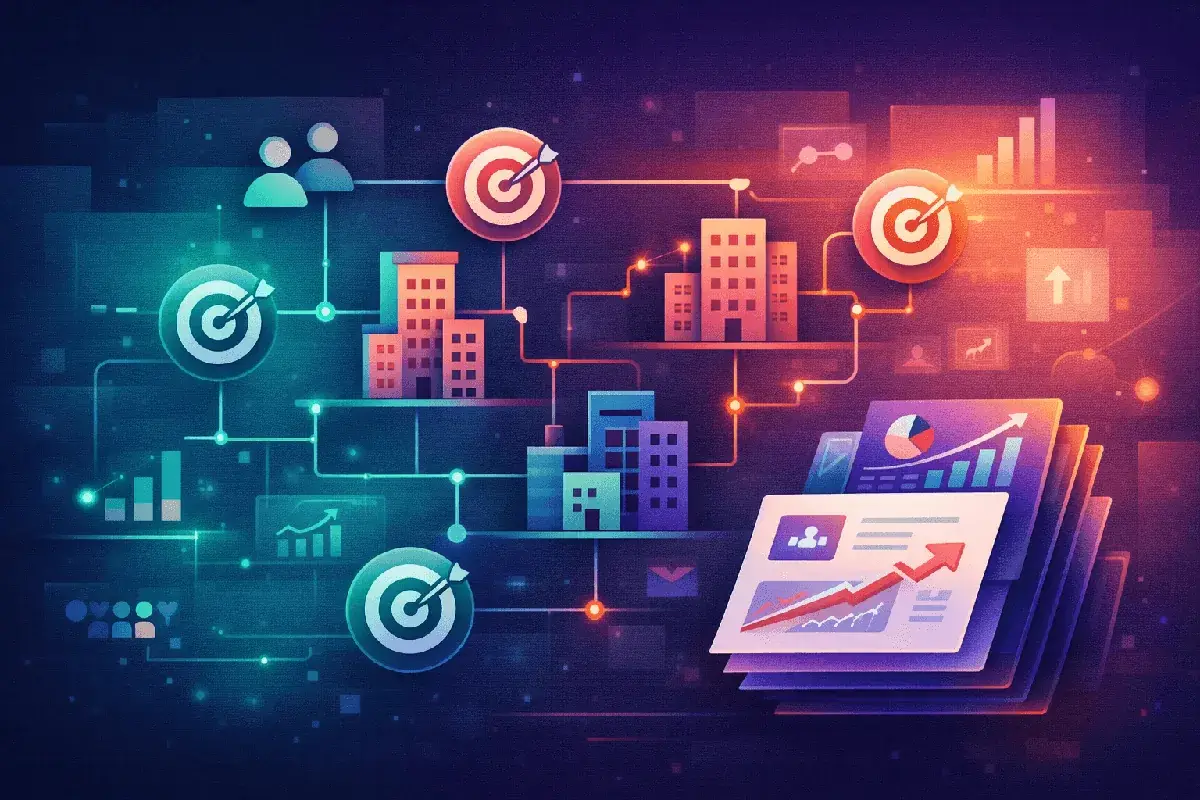
Account-Based Marketing—or as we prefer to call it, ABX (Account-Based Experience)—has transformed from a buzzword into a strategic imperative. According to ITSMA research, 87% of marketers report that ABM outperforms all other marketing investments in terms of ROI. Companies that have deployed ABM practices consistently report stronger pipeline velocity, higher win rates, and more efficient use of marketing resources.
But ABM isn’t just a tactic—it’s a fundamental shift in how B2B marketing and sales work together. This guide explores where ABM came from, why it matters now more than ever, and how to implement ABM 2.0 strategies that deliver measurable results.
The evolution of ABM from tactic to strategy
ABM has been around for about a decade, but the last five years have seen explosive adoption. What changed?
| Era | Approach | Limitation |
|---|---|---|
| 2010-2015 | Lead-based marketing | High volume, low quality MQLs |
| 2015-2020 | ABM 1.0 | Manual targeting, limited scale |
| 2020-Present | ABM 2.0 / ABX | AI-powered, signal-driven, personalized |
The shift away from MQL-focused strategies reflects a fundamental truth: sales teams were drowning in leads they didn’t want. ABM solves this by aligning marketing and sales around shared target accounts.
For companies implementing ABM, dedicated services can accelerate time-to-value significantly.
Understanding your total addressable market
Here’s the uncomfortable reality about B2B marketing:
| Market Segment | % of TAM | Status |
|---|---|---|
| In-market now | 3-8% | Active buying journey |
| Future buyers (6-12 months) | 15-20% | Problem aware, not solution seeking |
| Potential fit | 40-50% | Could buy eventually |
| Not a fit | 25-35% | Wrong size, industry, or needs |
At any given moment, only 3-8% of your Total Addressable Market is actively buying. Traditional marketing blasts the entire market hoping to catch that small percentage. ABM takes a smarter approach:
- Identify accounts most likely to be in-market
- Prioritize based on signals and fit
- Personalize messaging to specific account situations
- Coordinate marketing and sales touchpoints
Why traditional approaches are failing
In recent years, B2B marketers have struggled because:
Product-Led Growth Saturation
- PLG strategies no longer deliver sufficient lead volume for enterprise sales
- Competition for bottom-of-funnel keywords has intensified
- Self-serve models don’t work for complex, high-value deals
Generic Brand Campaigns
- Awareness without targeting is expensive and inefficient
- Campaigns aren’t designed to progress specific accounts through the funnel
- No connection between brand spend and pipeline impact
Outbound Channel Exhaustion
- Email deliverability has plummeted as inboxes are overwhelmed
- Cold calling connect rates have dropped below 2%
- Generic outreach is filtered or ignored
ABM provides an alternative: precise targeting, personalized messaging, and coordinated engagement that cuts through the noise.
What is ABM 2.0?
ABM 2.0—or Account-Based Experience (ABX)—leverages technology and data to scale what was once a manual, resource-intensive process:
Signal categories for targeting
| Signal Type | Examples | Data Sources |
|---|---|---|
| Firmographic | Company size, industry, revenue | CRM, enrichment tools |
| Technographic | Tech stack, tools in use | BuiltWith, HG Insights |
| Intent | Topic research, competitor visits | Bombora, G2, 6sense |
| Behavioral | Website visits, content downloads | Marketing automation |
| Trigger Events | Funding, executive changes, expansion | News feeds, ZoomInfo |
Dynamic ICP (ideal customer profile) markers
Rather than static company lists, ABM 2.0 uses dynamic signals to identify accounts:
- New executive in target role (CEO, CMO, CIO changes)
- Funding announcements (Series B+, private equity)
- Hiring patterns (marketing team expansion)
- Technology changes (new tool adoption)
- Regulatory shifts (compliance requirements)
These triggers indicate moments when accounts are most receptive to new solutions.
The ABM technology stack
Modern ABM requires integrated technology:
| Category | Tools | Purpose |
|---|---|---|
| Account Intelligence | Demandbase, 6sense | Identify and prioritize accounts |
| Intent Data | Bombora, G2 | Detect buying signals |
| Personalization | Mutiny, Intellimize | Website personalization |
| Sales Engagement | Outreach, SalesLoft | Coordinated outreach |
| Advertising | LinkedIn, Google Display | Account-targeted ads |
| Orchestration | Demandbase One, 6sense | Workflow automation |
The key is integration—tools must share data to provide a unified view of account engagement.
Implementing ABM a phased approach
Phase 1: foundation (4-6 weeks)
Objective: Align teams and identify target accounts
| Activity | Owner | Deliverable |
|---|---|---|
| Define ICP | Marketing + Sales | Documented ideal customer profile |
| Build account list | Revenue Ops | Tiered target account list |
| Map buying committee | Sales | Key contacts per account |
| Align metrics | Leadership | Shared KPIs and dashboards |
Phase 2: pilot program (8-12 weeks)
Objective: Test approach with limited account set
- Select 25-50 accounts for pilot
- Develop personalized content and messaging
- Execute coordinated campaigns
- Measure engagement and pipeline impact
- Gather feedback for iteration
Phase 3: scale (ongoing)
Objective: Expand proven approach across account tiers
| Account Tier | Number | Personalization Level | Resources |
|---|---|---|---|
| Tier 1 | 10-25 | Fully customized | 1:1 dedicated |
| Tier 2 | 50-100 | Segment personalization | 1:few |
| Tier 3 | 200-500 | Industry/persona personalization | 1:many |
What ABM actually delivers
Companies with mature ABM programs report significant improvements:
| Metric | Improvement | Timeframe |
|---|---|---|
| Pipeline conversion rate | 2x higher | 6-12 months |
| Deal velocity | 25% faster | 6-12 months |
| Win rate | 30% improvement | 12+ months |
| Marketing-engaged bookings | 45% increase | 6-12 months |
| Customer lifetime value | 35% higher | 24+ months |
Forrester Research found that companies with mature ABM programs generate 208% more revenue from marketing efforts than those without.
ABM content strategy
Content is the fuel for ABM. Create assets mapped to account needs:
Content by buying stage
| Stage | Content Type | Purpose |
|---|---|---|
| Problem Unaware | Industry trends, research | Establish relevance |
| Problem Aware | Educational guides, benchmarks | Build credibility |
| Solution Aware | Comparison guides, demos | Differentiate |
| Vendor Selection | Case studies, ROI calculators | Prove value |
| Decision | Proposals, implementation plans | Close |
Use our marketing calculator as an example of interactive content that engages prospects.
Personalization levels
| Level | Elements Personalized | Effort |
|---|---|---|
| Basic | Industry, company name | Low |
| Moderate | Pain points, use cases | Medium |
| Advanced | Account-specific challenges, stakeholder names | High |
For high-value Tier 1 accounts, personalization should extend to email campaigns with account-specific messaging.
Measuring ABM success
Move beyond lead metrics to account-based measurement:
Account-level metrics
| Metric | Definition | Target |
|---|---|---|
| Account Engagement Score | Composite of all account interactions | Increasing trend |
| Buying Committee Coverage | % of decision-makers engaged | 60%+ |
| Content Consumption | Assets viewed per account | 5+ assets |
| Intent Score Changes | Movement in buying signals | Trending up |
Pipeline metrics
| Metric | Definition | Target |
|---|---|---|
| Account-to-Opportunity Rate | % of target accounts becoming opportunities | 15-25% |
| Average Deal Size | Revenue from ABM accounts | 20%+ higher than non-ABM |
| Sales Cycle Length | Days from engagement to close | 25% reduction |
| Win Rate | Deals won / deals created | 30%+ higher |
Common ABM mistakes to avoid
- Skipping sales alignment - ABM requires joint planning and shared goals
- Too many target accounts - Quality over quantity; start small
- Generic content - Personalization is the point; generic defeats purpose
- No clear triggers - Know what actions indicate readiness for sales
- Technology before strategy - Tools amplify strategy; they don’t replace it
- Impatience - ABM results take 6-12 months to fully materialize
Getting started with ABM
Ready to implement ABM for your organization? Here’s your roadmap:
- Align marketing and sales on target account criteria
- Identify your initial target account list (start with 25-50)
- Research account-specific challenges and buying committees
- Create personalized content and messaging
- Orchestrate coordinated multi-channel campaigns
- Measure account engagement and pipeline impact
- Optimize based on results and feedback
Review our case studies for examples of ABM success with B2B technology companies.
This article has been co-written by Alizée Varloud at MyDigipal and Bruce Eidsvik at TheRC.
Ready to implement Account-Based Marketing for your organization? Contact our team for a strategic consultation.