Why ABM ROI measurement is different in B2B tech
Account-based marketing has fundamentally changed how B2B tech companies approach growth. Rather than casting a wide net and hoping the right prospects bite, ABM focuses resources on high-value target accounts that match your ideal customer profile. According to ITSMA research, 87% of B2B marketers report that ABM delivers higher ROI than any other marketing strategy.
But here is the challenge: measuring that ROI is far more nuanced than traditional demand generation metrics. In B2B tech, where average deal sizes range from ,000 to ,000+ and sales cycles stretch 6 to 18 months, the metrics that matter for ABM are fundamentally different from those used in broad-based marketing.
A comprehensive ABM strategy requires equally comprehensive measurement — one that tracks engagement, pipeline influence, and revenue impact at the account level rather than the individual lead level.
The ABM Measurement Framework: Four Pillars of Success
Pillar 1: Account Coverage and Reach
Before you can influence an account, you need to reach it. Coverage metrics tell you whether your ABM programs are actually getting in front of the right people at target accounts.
Key metrics to track:
| Metric | What It Measures | Benchmark |
|---|---|---|
| Account Coverage Rate | % of target accounts reached by marketing | 70-85% |
| Contact Coverage | Avg. contacts engaged per target account | 5-12 contacts |
| Buying Committee Penetration | % of identified decision-makers reached | 40-60% |
| Channel Coverage | # of channels touching each account | 3-5 channels |
B2B tech buying committees typically include 6 to 10 decision-makers across IT, procurement, finance, and line-of-business roles. If your ABM program is only reaching 2 contacts per account, you are missing critical influencers.
Pillar 2: Account Engagement
Engagement metrics reveal how deeply target accounts are interacting with your brand across all touchpoints. This is where tracking and reporting becomes essential.
Engagement Scoring Model:
- Website visits from target accounts (tracked via IP/reverse DNS or ABM platforms): 1-3 points per visit
- Content downloads (whitepapers, case studies, technical docs): 5-10 points per asset
- Email engagement from targeted campaigns: 2-5 points per open/click
- Ad interactions via Google Ads and paid social: 1-5 points per interaction
- Event attendance (webinars, demos, conferences): 10-25 points per event
- Direct sales interactions (meetings, calls, POC requests): 25-50 points each
A well-performing ABM program should see engagement scores increase by 30-50% within the first 90 days of activation for a target account.
Pillar 3: Pipeline Impact
Pipeline metrics connect your ABM efforts directly to revenue opportunities. This is where ABM proves its value to the C-suite.
Critical pipeline metrics:
- ABM-Sourced Pipeline: New opportunities directly created by ABM touchpoints ()
- ABM-Influenced Pipeline: Existing opportunities where ABM touchpoints accelerated or expanded the deal
- Pipeline Velocity: How quickly ABM accounts move through stages compared to non-ABM accounts
- Average Deal Size: Comparison of ABM vs. non-ABM deal values
- Win Rate: Conversion percentage of ABM opportunities vs. general pipeline
Research from Demandbase shows that ABM programs in tech companies deliver:
- 171% increase in average contract value
- 36% higher win rates compared to non-ABM deals
- 24% faster pipeline velocity
Pillar 4: Revenue and ROI
Ultimately, ABM must deliver measurable revenue impact. Here is how to calculate true ABM ROI:
ABM ROI Formula:
ABM ROI = (Revenue from ABM accounts - Total ABM investment) / Total ABM investment x 100
Total ABM Investment includes:
- ABM platform costs (Demandbase, 6sense, Terminus, RollWorks)
- Dedicated ABM headcount
- ABM-specific content creation
- Targeted advertising spend
- Sales enablement for ABM accounts
- Technology and data costs
According to the ABM Leadership Alliance, companies with mature ABM programs achieve an average ROI of 200-300% on their ABM investment.
Building Your ABM Measurement Tech Stack
Essential Tools for B2B Tech ABM Measurement
| Category | Tools | Purpose |
|---|---|---|
| ABM Platform | Demandbase, 6sense, Terminus | Account identification, intent data, orchestration |
| CRM | Salesforce, HubSpot | Pipeline and revenue tracking |
| Marketing Automation | Marketo, Pardot, HubSpot | Campaign execution and engagement tracking |
| Analytics | Google Analytics 4, Bizible | Multi-touch attribution |
| Intent Data | Bombora, G2, TrustRadius | Buying signal detection |
| Sales Engagement | Outreach, SalesLoft | Sales touchpoint tracking |
The most critical integration is between your ABM platform and CRM. Without this connection, you cannot accurately attribute pipeline and revenue to ABM activities.
AI-powered solutions are increasingly playing a role in ABM measurement, using machine learning to identify which account-level signals best predict conversion and to optimize engagement across channels automatically.
ABM KPIs by Stage: What to Measure When
Stage 1: Program Launch (Months 1-3)
Focus on leading indicators:
- Account identification accuracy: Are you targeting the right accounts?
- Coverage metrics: Are you reaching target accounts and buying committees?
- Initial engagement lift: Are target accounts showing increased interest?
- Sales alignment score: Are sales teams engaged with ABM target accounts?
Stage 2: Program Maturation (Months 3-9)
Shift to pipeline indicators:
- Marketing Qualified Accounts (MQAs): Accounts exceeding engagement thresholds
- Sales Accepted Accounts (SAAs): MQAs that sales agrees to pursue
- Pipeline generation: New opportunities from ABM accounts
- Meeting rate: ABM-sourced meetings booked per account
Stage 3: Revenue Impact (Months 9-18)
Measure bottom-line results:
- Closed-won revenue from ABM accounts
- ABM ROI (using the formula above)
- Customer acquisition cost comparison (ABM vs. non-ABM)
- Customer lifetime value of ABM-acquired accounts
- Expansion revenue from ABM-landed accounts
Real-World ABM ROI Benchmarks for B2B Tech
Industry-Specific Performance Data
| Company Size | Avg. ABM Investment | Avg. Pipeline Generated | Typical ROI |
|---|---|---|---|
| Startup (50-200 emp.) | 100K-300K per year | 1M-5M pipeline | 150-250% |
| Mid-Market (200-2000) | 300K-1M per year | 5M-20M pipeline | 200-350% |
| Enterprise (2000+) | 1M-5M per year | 20M-100M+ pipeline | 250-400% |
Key Benchmark Insights
- Time to first ABM-sourced opportunity: 45-90 days
- Average touchpoints before account conversion: 15-25 across 4-6 channels
- Email engagement rates for ABM vs. broad campaigns: ABM emails see 2-3x higher open rates and 4-5x higher click rates
- ABM account win rates vs. inbound leads: ABM accounts close at rates 40-60% higher than standard inbound leads
Common ABM ROI Measurement Mistakes
1. Measuring at the Lead Level Instead of Account Level
The biggest mistake B2B tech marketers make is applying traditional lead-based metrics to ABM. Metrics like cost-per-lead (CPL) and marketing qualified leads (MQLs) are fundamentally incompatible with ABM.
Instead, use: Cost-per-target-account-engaged, Marketing Qualified Accounts (MQAs), and revenue-per-account.
2. Expecting Immediate Results
ABM is a long-term strategy. Companies that abandon ABM after 3 months because they have not seen pipeline never gave the program a chance to work. Most B2B tech case studies show that ABM programs hit their stride between months 6 and 12.
3. Ignoring Influenced Revenue
If you only measure ABM-sourced revenue (first-touch attribution), you are dramatically undervaluing your ABM program. ABM often influences deals that were originated by other channels — and that influence is enormously valuable.
4. Not Segmenting Results by Tier
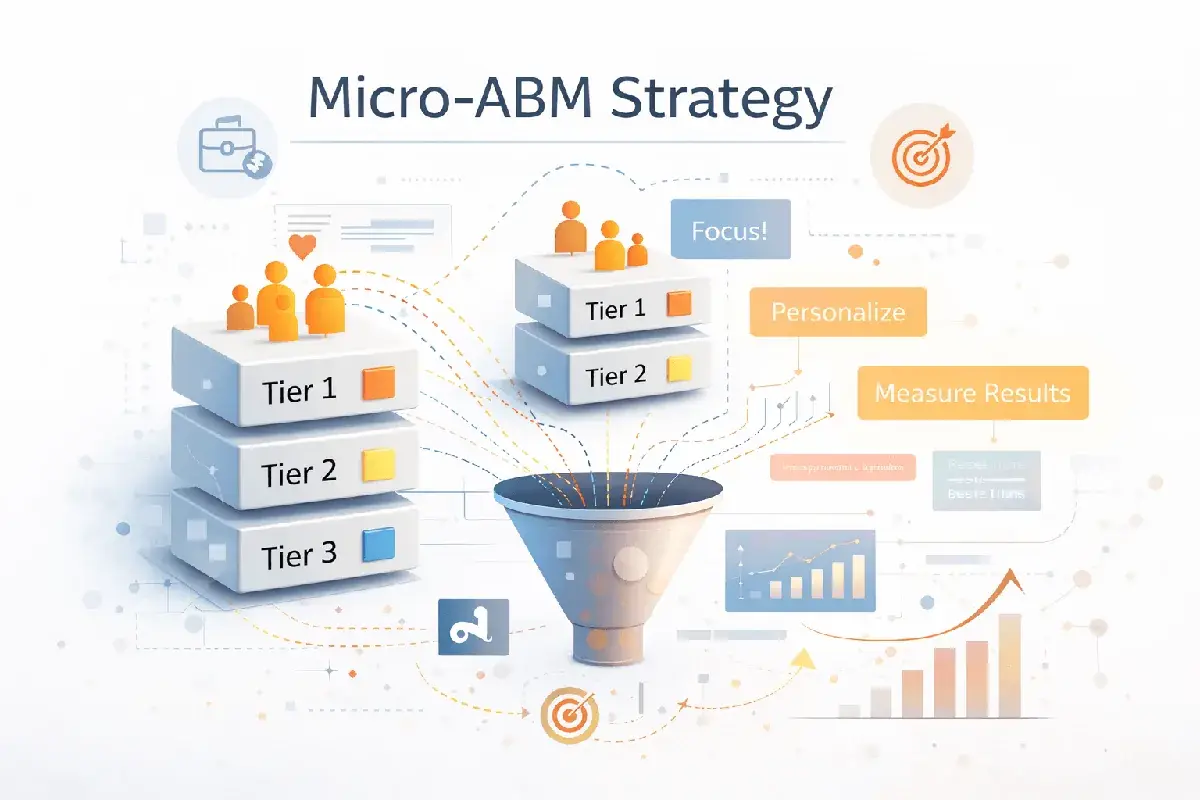
Most ABM programs use a tiered approach (1:1 for top accounts, 1:few for cluster accounts, 1:many for broader targeting). Measuring all tiers with the same KPIs creates misleading results. Tier 1 accounts should show higher engagement and deal sizes, while Tier 3 should show higher volume.
5. Overlooking Sales Alignment Metrics
ABM fails without sales buy-in. Track metrics like sales follow-up rate on ABM accounts, joint account planning completion, and sales satisfaction with ABM-provided insights. If sales is not engaged, even the best marketing will not convert.
Optimizing ABM ROI: Data-Driven Strategies
Strategy 1: Intent Data Integration
Layering intent data from providers like Bombora or 6sense onto your target account list can improve ABM engagement rates by 35-50%. Intent data tells you which accounts are actively researching solutions in your category, allowing you to time your outreach perfectly.
Strategy 2: Personalized Content at Scale
B2B tech buyers expect personalized experiences. Using AI-powered content creation and SEO strategies tailored to target accounts can increase content engagement by 200-300% compared to generic assets.
Strategy 3: Multi-Channel Orchestration
The most successful ABM programs coordinate messaging across 5 or more channels simultaneously. This includes:
- Targeted display and social advertising via paid social
- Personalized email sequences through marketing automation
- Custom landing pages and website personalization
- Direct mail and gifting for Tier 1 accounts
- SDR outreach synchronized with marketing touches
Strategy 4: Continuous Account Scoring Refinement
Your account scoring model should evolve based on data. Analyze which engagement signals actually predict pipeline creation and adjust weights accordingly. Accounts that attend webinars may convert at 3x the rate of those who only visit your website — your scoring should reflect this.
Building an ABM Dashboard for B2B Tech Leadership
Executive Dashboard Essentials
Your ABM reporting should include:
- Account Funnel Visualization: Target accounts > Engaged > MQA > Opportunity > Won
- Pipeline Waterfall: ABM-sourced vs. ABM-influenced pipeline by quarter
- Engagement Heatmap: Visual representation of account engagement across channels
- ROI Trend: Rolling 12-month ABM ROI with investment overlay
- Competitive Intelligence: Win/loss analysis for ABM vs. non-ABM deals
Regular tracking and reporting ensures that your ABM program stays aligned with business objectives and that you can demonstrate value to stakeholders at every stage.
Accelerate Your ABM Results with MyDigipal
At MyDigipal, we specialize in building and measuring high-performance ABM programs for B2B tech companies. Our team combines deep ABM expertise with advanced tracking and analytics, targeted paid media, and AI-powered personalization to deliver measurable account-level results.
Whether you are launching your first ABM program or optimizing an existing one, we help you build the measurement framework that proves ROI and secures continued investment.
Ready to measure and maximize your ABM ROI? Contact our ABM specialists for a complimentary strategy session and benchmark assessment.