Case study · Deep dive · Tracking
Tracking that tells the truth
A booking nobody counted, a call back request stuck at zero, the same lead counted twice. Three invisible failures we find on almost every dealership website, and how we fix them.
Tracking of forms, calls and bookings on dealership websites
What gets in the way
Three failures nobody sees
A booking nobody counted, a call back request stuck at zero, the same lead counted twice. None of them shows an error. All of them distort decisions.
An ad platform learns from what you tell it. Tell it a lead is worth two, or that a booking does not count, and it optimises on a false reality, sending the budget to the wrong place.
The most common failure
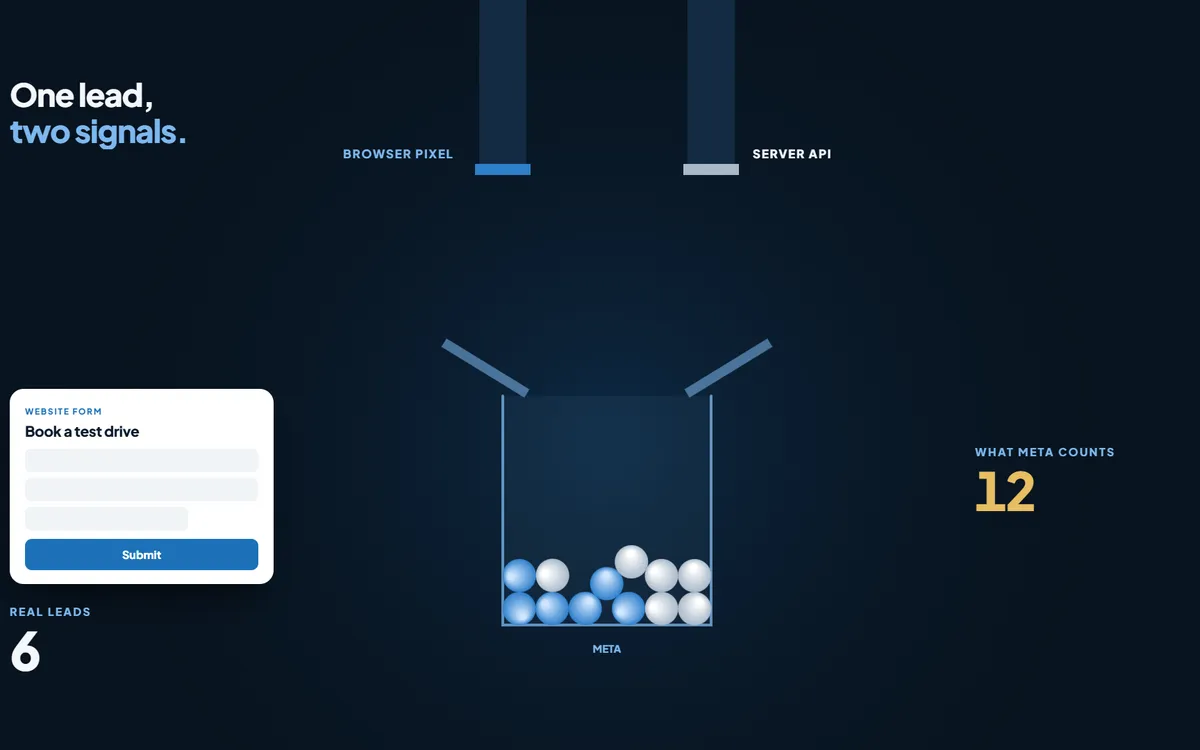
One lead, two signals
The browser and the server each send their own signal for the same lead. Without a shared identifier, the platform counts two. At GGP, the dashboard showed 146 Meta leads for 101 real ones.
What we found, and fixed
Three cases, three fixes
At Auto ici, the test drive booking, the site's most important conversion, was no longer tracked. It is again.
The "call back request" conversion stayed at zero: the settings were ready but never published. One publish, and it came through.
At GGP, one tool on the site sent the same signal as another: +45% extra leads, fixed in our data.
At Théobald, the audit score went from 62 to 88 out of 100 in one week.
Every dealership site and every brand micro-site is checked, not just the main website.
Tracking only fires with the visitor's consent, and we check it in real conditions, not in the settings.
« Leads land directly in our calling software, without duplicates: the call centre can call back straight away. »
Checklist
Your tracking in six checks
What we check on every dealership website, at the start and then every month.
- Test like a customer
Fill in the form, call, book: and look at what actually goes out, not at what the settings say.
- One signal per lead
The same identifier for browser and server, so the platform only counts one.
- The conversions that matter
Forms, bookings, calls longer than a minute: we do not feed campaigns with clicks.
- Publish everything
A setting prepared but not published counts nothing. We check the live version.
- Every site
The main website, brand sites, used cars: every entry point is tracked.
- A review every month
A site changes, a tool gets added: every month we compare the site's numbers with the platforms'.
Your numbers, in your area
You don’t need €30,000 a month to sell cars. Tell us what you sell, your budget and your area: the estimate starts from the results of the dealer accounts we run.
Pick your town: the estimate appears here.
possible sales per month
- Leads (forms and calls)
- Cost per lead
- Clicks on your ads
- Impressions per month
The population data for your area could not load. Reload the page to try again.
Indicative estimate, based on the dealer accounts we run (Google Ads and Meta, last twelve months). It is not a promise: results depend on your stock, your prices and how fast your team calls back.
Frequently asked questions
Tracking: what we get asked
How do I know if my tracking is wrong?
Compare three numbers over the same month: leads received by the dealership, those in the dashboard, those in the ad platform. A gap above 10% deserves an audit.
Is server-side tracking a must?
Not always. It recovers signals lost by browsers, but it doubles the risk of counting twice if the shared identifier is missing.
What about consent?
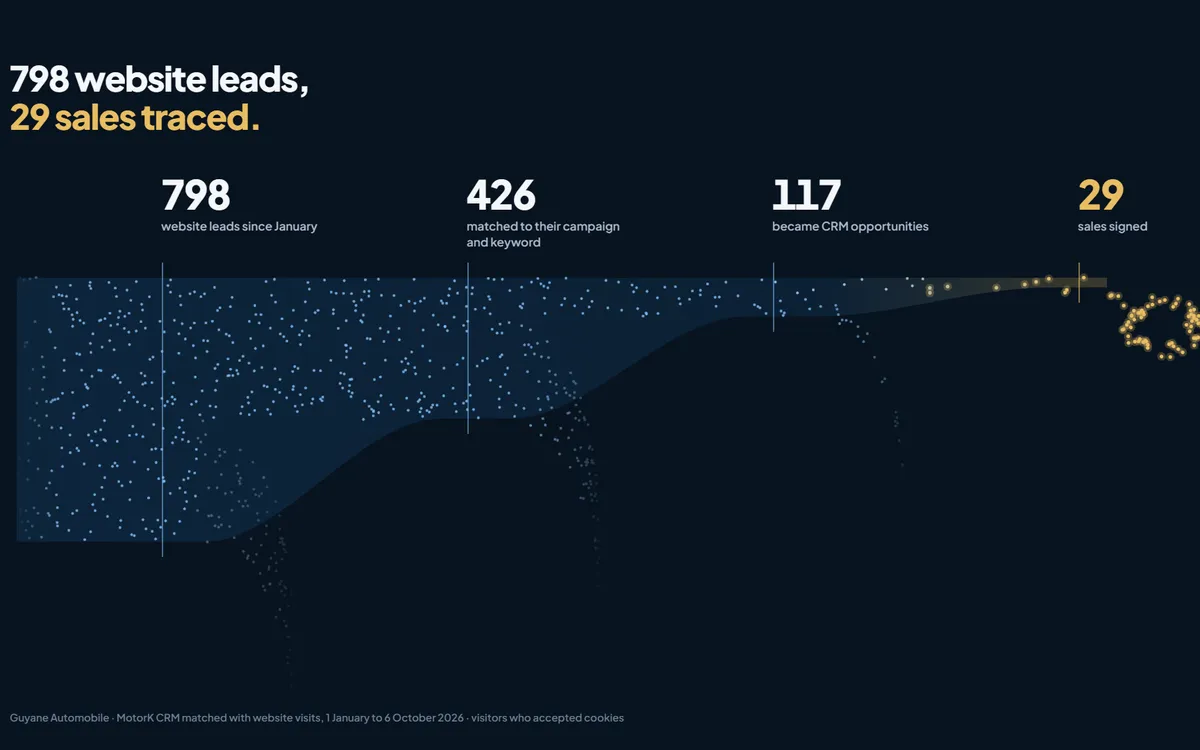
Tracking only fires with the visitor's consent. Matched numbers therefore only cover those who gave it, and we say so in every report.
Other case studies


What would it look like for your dealerships?
The calculator prices your campaigns in two minutes. Or write to us: we reply within 24 hours.