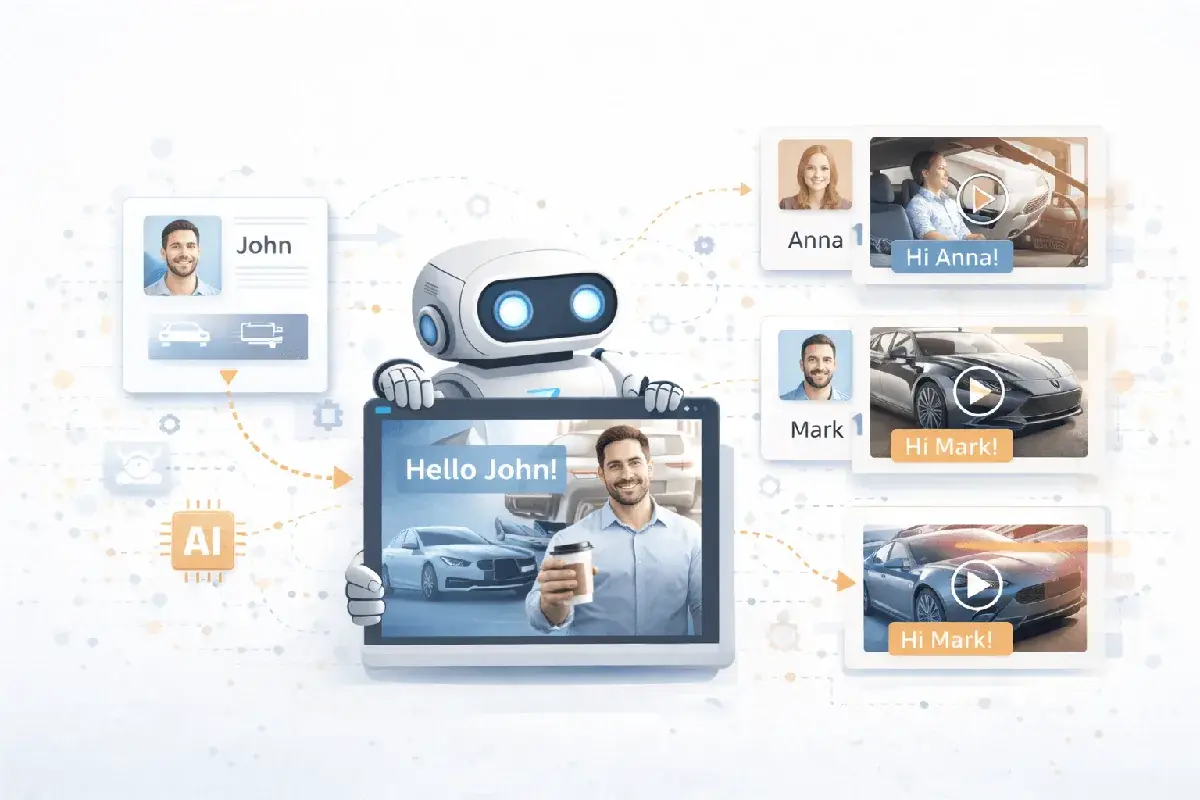
Why automotive marketing needs a data revolution
The automotive industry sits at a paradox. Marketers need massive volumes of customer data to optimize campaigns across complex, multi-touchpoint buyer journeys that average 6-9 months. Yet GDPR, CCPA, and emerging privacy regulations have made accessing and using real customer data increasingly restricted.
Consider the numbers: a typical automotive OEM collects data from 15-25 different touchpoints before a vehicle purchase, from configurator interactions to dealership visits, test drive bookings to financing applications. Each data point carries privacy obligations that limit how it can be used for testing and optimization.
Synthetic data offers a breakthrough solution. By generating statistically accurate but entirely artificial datasets, automotive marketers can test at scale, train AI models, and personalize campaigns without ever touching real customer information.
What is synthetic data and why should marketers care?
Synthetic data is artificially generated information that mirrors the statistical properties, patterns, and correlations of real-world data without containing any actual personal information. Think of it as a digital twin of your customer database that behaves identically in analysis but cannot be traced back to any real individual.
According to Gartner, by 2026, 60% of the data used for AI and analytics projects will be synthetically generated. For automotive marketers, this represents a seismic shift in how campaigns are developed, tested, and optimized.
Key advantages for automotive marketing
| Benefit | Impact | Real-World Application |
|---|---|---|
| GDPR Compliance | Eliminates personal data risk | Test campaigns across EU markets freely |
| Scale | Generate unlimited datasets | Simulate millions of buyer journeys |
| Speed | No data procurement delays | Launch A/B tests in hours, not weeks |
| Cost Reduction | 40-60% lower data costs | Reduce reliance on expensive data providers |
| Edge Case Testing | Model rare scenarios | Test campaigns for niche vehicle segments |
How synthetic data transforms automotive campaign testing
1. Ad creative testing without privacy constraints
Traditional A/B testing of Google Ads campaigns requires real user interactions, meaning real personal data flowing through your systems. Synthetic data changes this equation entirely.
Practical application: Generate synthetic audience profiles that mirror your actual customer segments, including demographics, vehicle preferences, financing behavior, and digital engagement patterns. Use these profiles to:
- Pre-test ad creative variations across hundreds of synthetic audience segments before spending a single euro on media
- Simulate click-through and conversion patterns based on historical correlations
- Identify optimal messaging for each stage of the automotive buyer journey
A major European OEM reported 23% improvement in campaign ROI after implementing synthetic data-driven pre-testing, reducing wasted ad spend by eliminating underperforming creatives before launch.
2. Personalization engine training
Modern AI-powered content solutions require enormous training datasets. For automotive brands, this means feeding algorithms with customer interaction data spanning configurator sessions, dealership interactions, service appointments, and ownership lifecycle events.
Synthetic data enables you to:
- Train recommendation engines that suggest vehicles, features, and accessories based on synthetic behavioral patterns
- Build predictive models for lead scoring without exposing real prospect data
- Test personalization algorithms across diverse demographic segments including edge cases with insufficient real data
3. Cross-market campaign simulation
Automotive brands operating across multiple European markets face varying privacy regulations. Synthetic data provides a unified testing environment where campaigns can be simulated across markets without navigating different consent frameworks.
Case example: A luxury automotive brand used synthetic data to simulate campaign performance across 12 European markets simultaneously. By generating market-specific synthetic datasets reflecting local buying behaviors, they:
- Reduced campaign localization time by 45%
- Identified 3 previously overlooked market segments worth EUR 2.1M in incremental revenue
- Achieved consistent tracking and reporting across all markets without cross-border data transfer concerns
Building your synthetic data pipeline
Step 1: audit your current data assets
Before generating synthetic data, you need to understand what real data you have and how it is structured. Conduct a comprehensive audit of:
- CRM data: Customer demographics, purchase history, service records
- Digital analytics: Website behavior, configurator interactions, email engagement
- Advertising data: Campaign performance, audience segments, conversion paths
- Dealership data: Walk-in traffic, test drive bookings, negotiation patterns
Step 2: choose your generation approach
Three primary methods exist for generating synthetic marketing data:
Statistical modeling: Uses probability distributions to generate new data points. Best for simple datasets with well-understood patterns. Accuracy: 80-85%.
Generative Adversarial Networks (GANs): AI models that learn to generate data indistinguishable from real datasets. Best for complex, multi-dimensional data. Accuracy: 90-95%.
Agent-based simulation: Creates virtual customer agents that behave according to defined rules and interact with simulated marketing touchpoints. Best for journey-level testing. Accuracy: 85-92%.
Step 3: validate and calibrate
Synthetic data is only valuable if it accurately reflects real-world patterns. Implement a rigorous validation framework:
- Statistical fidelity tests: Compare distributions, correlations, and outlier patterns between synthetic and real data
- Utility testing: Run identical analyses on both datasets and compare outputs
- Privacy verification: Use re-identification risk assessments to confirm synthetic data cannot be linked to real individuals
- Marketing-specific validation: Compare predicted campaign performance metrics with actual historical results
Step 4: integrate with your marketing stack
Synthetic data should flow seamlessly into your existing tools. Key integration points include:
- Ad platforms: Feed synthetic audiences into Google Ads and paid social simulation tools
- CRM systems: Test segmentation and automation workflows
- Analytics platforms: Validate attribution models and reporting dashboards
- AI solutions: Train and fine-tune machine learning models
GDPR compliance: the definitive advantage
Why synthetic data sidesteps GDPR concerns
GDPR applies to personal data, defined as information relating to an identified or identifiable natural person. Properly generated synthetic data, by definition, does not relate to any real person. This means:
- No consent required for data processing
- No data subject access requests to manage
- No cross-border transfer restrictions under GDPR Chapter V
- No data breach notification obligations since no personal data can be compromised
- No Data Protection Impact Assessments required for synthetic datasets
Important caveats
While synthetic data offers significant compliance advantages, automotive marketers must still observe important guardrails:
- The source data used to train synthetic generators must be lawfully collected. You cannot launder non-compliant data through synthetic generation.
- Re-identification risk must be negligible. Use differential privacy techniques and conduct regular re-identification audits.
- Document your methodology. Maintain clear records of how synthetic data is generated and validated.
- Engage your Data Protection Officer. Even though synthetic data may fall outside GDPR scope, involve your DPO in the implementation process for governance purposes.
Real-world results: automotive brands leading the way
Performance benchmarks
Organizations that have adopted synthetic data for marketing optimization report significant improvements:
- 32% faster campaign launch cycles due to eliminated data procurement and privacy review delays
- 28% improvement in predictive model accuracy thanks to larger, more diverse training datasets
- 41% reduction in compliance-related project delays across multi-market campaigns
- EUR 1.2M average annual savings on third-party data procurement for mid-size automotive brands
Industry adoption trends
The automotive sector is accelerating its adoption of synthetic data. According to recent industry surveys:
- 47% of automotive marketing leaders plan to implement synthetic data solutions by end of 2026
- 73% cite GDPR compliance as the primary driver for adoption
- 62% expect synthetic data to become their primary testing dataset within 3 years
Advanced use cases: beyond campaign testing
Customer journey simulation
Synthetic data enables automotive marketers to simulate complete customer journeys from first touchpoint to purchase and beyond. By generating thousands of synthetic buyer personas with realistic behavioral patterns, you can:
- Model the impact of different marketing touchpoint sequences on conversion probability
- Identify the optimal number and type of touchpoints needed to move prospects through each funnel stage
- Test the effectiveness of new channels before investing in real campaigns
- Simulate the impact of budget reallocation across channels without real-world risk
A leading European automotive group used synthetic journey simulation to discover that their email nurture sequences were over-indexed on vehicle features and under-indexed on financing options. After rebalancing based on synthetic data insights, they saw a 17% increase in test drive bookings from email campaigns.
Audience expansion and lookalike modeling
Traditional lookalike audience building relies on platform algorithms and limited seed audiences. Synthetic data opens new possibilities:
- Generate synthetic profiles that represent underserved market segments based on demographic and behavioral modeling
- Test audience expansion strategies before committing media budget
- Validate new market entry hypotheses by simulating audience response patterns in untested geographies
- Build custom affinity models that combine automotive-specific behavioral signals unavailable through standard platform targeting
Dealership performance benchmarking
For automotive groups with multiple dealership locations, synthetic data enables privacy-safe performance benchmarking:
- Compare digital marketing performance across dealerships without sharing customer-level data
- Identify best-practice patterns from top-performing locations and simulate their application across the network
- Test centralized versus localized marketing strategies using synthetic market models
- Evaluate the incremental impact of new digital initiatives before network-wide rollout
Connected vehicle data augmentation
As vehicles become increasingly connected, automotive marketers gain access to new data streams including driving behavior, vehicle health diagnostics, and location patterns. Synthetic data enables you to:
- Develop marketing models that incorporate connected vehicle signals before you have sufficient real data volume
- Test privacy-compliant activation strategies for connected vehicle data
- Simulate cross-channel journeys that span digital marketing, dealership interactions, and in-vehicle touchpoints
Getting started: a practical roadmap
Month 1-2: Foundation
- Audit existing data assets and identify high-value use cases
- Select synthetic data generation approach and technology partner
- Establish validation framework and success metrics
Month 3-4: Pilot
- Generate synthetic datasets for one priority use case (recommended: ad creative testing)
- Run parallel tests comparing synthetic-driven and traditional approaches
- Refine generation parameters based on validation results
Month 5-6: Scale
- Expand to additional use cases across the marketing mix
- Integrate synthetic data pipeline with your core marketing technology stack
- Establish ongoing monitoring and quality assurance processes
Conclusion: privacy-first marketing is performance marketing
Synthetic data is not merely a compliance workaround. It is a performance multiplier that enables automotive marketers to test more, learn faster, and optimize deeper than ever before. By removing the data access bottleneck, brands can finally achieve the scale and speed of testing that modern digital marketing demands.
The automotive brands that embrace synthetic data today will build a lasting competitive advantage in campaign optimization, customer personalization, and market intelligence, all while maintaining bulletproof privacy compliance.
Ready to unlock the power of synthetic data for your automotive marketing? MyDigipal combines deep automotive industry expertise with cutting-edge AI solutions to help brands build GDPR-compliant, data-driven marketing engines. Contact our team to explore how synthetic data can transform your campaign performance.