The .2 billion problem: Why generic automotive video campaigns fail
The automotive industry spends an estimated .2 billion annually on video advertising in North America alone. Yet the average test drive booking rate from video campaigns hovers at a dismal 0.4%. The reason is simple: a 45-year-old suburban parent shopping for a family SUV and a 28-year-old urban professional eyeing a compact EV receive the exact same video creative.
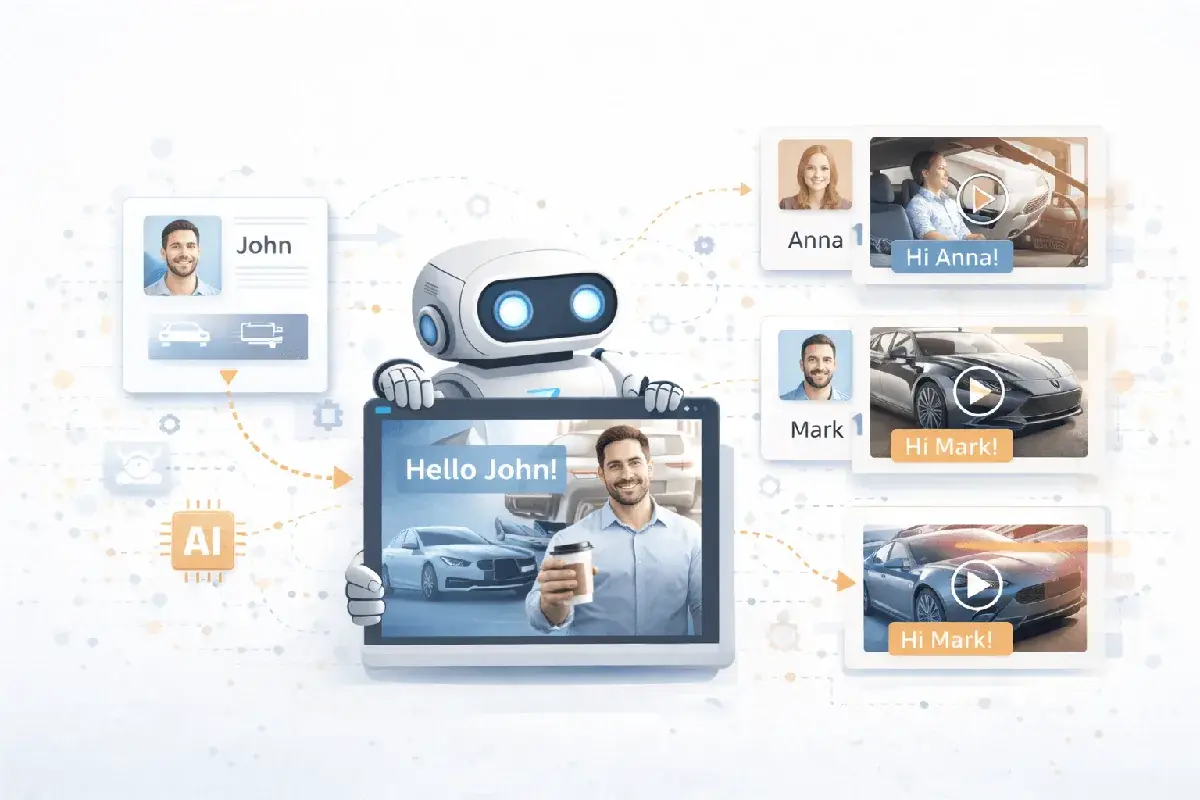
In 2026, this one-size-fits-all approach is not just inefficient—it is commercially indefensible. AI-powered video personalization has matured to the point where dealership networks can generate thousands of unique video variants from a single master asset, matching each prospect’s demographics, browsing behavior, geographic context, and purchase intent signals.
This article breaks down the technical architecture, implementation workflow, and measurable ROI of scaling personalized video test drive campaigns to 10,000+ prospects—and why leading OEMs and dealer groups are making it a cornerstone of their 2026 acquisition strategy.
How AI video personalization works: the technical stack
AI-powered video personalization combines three core technology layers:
1. Dynamic creative assembly
Rather than rendering thousands of individual videos, modern platforms use modular video architecture. A master video is deconstructed into interchangeable scenes:
| Scene Element | Personalization Variable | Example |
|---|---|---|
| Opening hook | Prospect name, city, weather | ”Good morning, Sarah. Perfect driving weather in London today.” |
| Vehicle showcase | Model, trim, color preference | 2026 Model X in Arctic White with Sport Package |
| Feature highlight | Browsing-behavior-based priorities | Safety features for family shoppers vs. performance specs for enthusiasts |
| Dealership CTA | Nearest location, available time slots | ”Book your test drive at our Laval location—slots open this Saturday.” |
| Incentive overlay | Segment-specific offers | Loyalty trade-in bonus vs. first-time buyer financing |
The AI engine assembles these modules in real time or near-real time, producing a cohesive video that feels fully custom-produced.
2. Prospect intelligence layer
Personalization is only as good as the data powering it. The intelligence layer ingests signals from multiple sources:
- CRM data: Purchase history, service records, lease expiration dates
- Website behavior: Pages viewed, configurator interactions, time-on-page patterns
- Third-party intent data: Cross-site browsing signals indicating active vehicle research
- Geographic and demographic data: Location, household composition, income indicators
- Engagement history: Previous email opens, ad clicks, video view completion rates
Modern AI solutions use machine learning models to synthesize these signals into a prospect profile score that determines which video modules to assemble and in what sequence.
3. Delivery and optimization engine
Personalized videos are delivered through multiple channels:
- Email campaigns with embedded video thumbnails linking to personalized landing pages
- Paid social placements on Meta and YouTube using dynamic creative optimization
- SMS/RCS messaging with video links for high-intent prospects
- Retargeting sequences triggered by specific website behaviors
The delivery engine continuously A/B tests element combinations and uses reinforcement learning to optimize assembly rules based on downstream conversion data.
The ROI case: what the data shows
Early adopters of AI video personalization in automotive are reporting transformative results:
Booking rate improvements
| Campaign Type | Generic Video | Personalized Video | Improvement |
|---|---|---|---|
| Conquest (new prospects) | 0.3% booking rate | 1.2% booking rate | +300% |
| Retention (existing customers) | 0.8% booking rate | 3.5% booking rate | +340% |
| Lease renewal | 1.1% booking rate | 4.2% booking rate | +280% |
| Service-to-sales crossover | 0.5% booking rate | 2.1% booking rate | +320% |
Cost efficiency gains
- Cost per test drive booked: Decreased by 62% compared to generic video campaigns
- Video production cost per variant: Dropped from ,500 per unique video (traditional production) to /usr/bin/bash.35 per personalized render (AI assembly)
- Campaign setup time: Reduced from 6-8 weeks (traditional) to 3-5 days (AI-powered)
- Creative team bandwidth: 85% reduction in manual creative production hours
Downstream sales impact
Dealerships using personalized video test drive campaigns report:
- 23% higher show rate for booked test drives (prospects feel more committed after personalized engagement)
- 18% faster sales cycle from first contact to purchase
- ,400 higher average transaction value attributed to better model/trim matching during the video stage
Implementation blueprint: from zero to 10,000+ personalized videos
Phase 1: data foundation (weeks 1-2)
Before generating a single personalized frame, you need clean, unified prospect data:
- Audit your CRM for data completeness—aim for 80%+ fill rate on key personalization fields
- Implement cross-channel tracking to capture website behavior, ad interactions, and email engagement in a single profile. A robust tracking and reporting infrastructure is non-negotiable.
- Define prospect segments: Start with 8-12 core segments based on purchase intent, vehicle category preference, and lifecycle stage
- Map data permissions: Ensure GDPR/CCPA compliance for every personalization variable you plan to use
Phase 2: creative architecture (weeks 2-3)
Work with your video production team to create modular master content:
- Shoot 15-20 interchangeable scene variants covering different models, features, and messaging angles
- Record dynamic audio tracks with variable name/location/offer insertion points
- Design overlay templates for pricing, incentives, and CTAs that can be dynamically populated
- Create thumbnail variants optimized for email, social, and display placements
Phase 3: AI assembly configuration (weeks 3-4)
Configure the personalization rules engine:
- Build assembly logic trees that map prospect attributes to scene selections
- Set up A/B testing frameworks to validate personalization hypotheses
- Configure quality assurance workflows to review a statistical sample of generated videos before bulk deployment
- Integrate with your email marketing platform and paid social channels for automated delivery
Phase 4: launch and optimize (week 5+)
- Start with a 500-prospect pilot to validate technical performance and initial conversion metrics
- Scale to full audience once pilot KPIs confirm positive ROI
- Implement weekly optimization cycles adjusting assembly rules based on conversion data
- Expand personalization depth by adding new scene modules and data variables each quarter
Advanced strategies: beyond basic personalization
Weather-triggered creative optimization
AI systems can adjust video content based on real-time weather data at the prospect’s location. Rainy forecast? Emphasize AWD capabilities and safety features. Sunny weekend ahead? Lead with convertible or sunroof footage with outdoor driving scenes.
Inventory-aware personalization
Connect your personalization engine to live dealership inventory feeds. Only showcase vehicles that are actually available at the prospect’s nearest location, with real pricing. This eliminates the frustration of engaging with content for unavailable models.
Behavioral trigger sequences
Create multi-touch personalized video sequences triggered by specific behaviors:
- Configurator abandonment → Video showcasing the exact configuration they built, with a limited-time incentive
- Repeat website visits (3+ in 7 days) → Video featuring customer testimonials for their preferred model
- Competitor research signals → Comparison-focused video highlighting advantages over the specific competitor they researched
AI-generated voiceover personalization
Latest text-to-speech AI can generate natural-sounding personalized voiceovers that address the prospect by name, reference their city, and customize the script based on their segment. Quality has reached the point where 67% of listeners cannot distinguish AI voiceover from human narration in blind tests.
Common pitfalls and how to avoid them
Pitfall 1: Over-personalization that feels invasive. Solution: Follow the “helpful, not creepy” rule. Personalize on preferences and behavior, not on sensitive personal data. Always provide value in exchange for the personalization.
Pitfall 2: Poor data quality producing irrelevant content. Solution: Implement data validation gates. If a prospect’s profile is less than 60% complete, default to segment-level personalization rather than individual-level.
Pitfall 3: Inconsistent brand experience across variants. Solution: Lock brand elements (logo placement, color palette, music, tone) as non-variable constants in your modular architecture.
Pitfall 4: Neglecting mobile optimization. Solution: 73% of automotive video consumption happens on mobile. Design all personalized variants mobile-first with vertical and square aspect ratios alongside landscape.
Measuring success: the KPI framework
Track these metrics at each funnel stage:
- Awareness: Video view rate, view-through rate (VTR), unique reach
- Engagement: Average watch time, completion rate, click-through rate
- Conversion: Test drive booking rate, cost per booking, booking-to-show rate
- Revenue: Influenced pipeline value, cost per sale, incremental revenue per personalized video dollar spent
Use advanced tracking and attribution to connect video engagement data to downstream CRM outcomes.
The competitive advantage window
AI video personalization in automotive is still in early adoption. According to industry data, fewer than 12% of dealership groups in North America have implemented any form of dynamic video personalization. This creates a significant first-mover advantage for brands and dealer networks that deploy now.
By 2027, analyst projections suggest adoption will exceed 45%, at which point personalization becomes table stakes rather than a differentiator. The window to build capability, accumulate optimization data, and establish performance benchmarks is now.
How MyDigipal accelerates your AI video strategy
At MyDigipal, we help automotive brands and dealer groups architect, implement, and optimize AI-powered video personalization campaigns that deliver measurable test drive bookings and sales pipeline growth.
Our team combines deep AI marketing expertise with automotive industry knowledge to:
- Design modular creative architectures tailored to your model lineup and audience segments
- Integrate personalization engines with your existing CRM, DMS, and marketing stack
- Deploy and optimize campaigns across paid social, email, and programmatic channels
- Provide transparent tracking and reporting connecting video engagement to showroom visits and sales
Ready to transform your test drive campaigns with AI-powered video personalization? Contact our automotive marketing team to schedule a strategy session and see personalized video in action with your own inventory data.
Explore our client success stories to see how we’ve helped automotive brands achieve breakthrough results with AI-driven marketing.