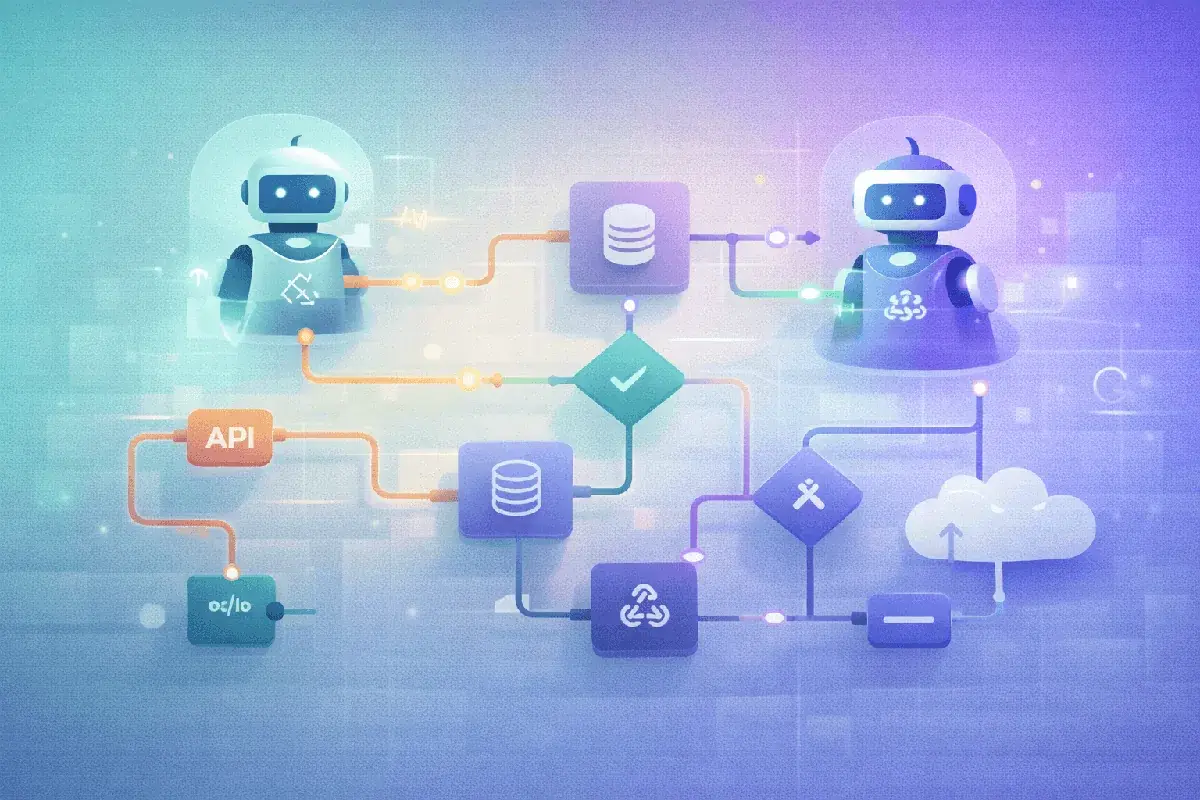
While the world obsesses over ChatGPT plugins and Copilot integrations, a quiet revolution is unfolding in open source AI. Developers and forward-thinking businesses are building autonomous AI agents that don’t just answer questions—they complete entire workflows, make decisions, and interact with real tools and APIs.
According to GitHub’s State of the Octoverse, AI-related open source projects grew 59% year-over-year, with agent frameworks seeing the fastest adoption. This isn’t hype—it’s a fundamental shift in how businesses can leverage AI.
What makes AI agents different
An AI agent is fundamentally different from a chatbot or assistant. Here’s the distinction:
| Capability | Traditional Chatbot | AI Agent |
|---|---|---|
| Input handling | Single query response | Goal-oriented planning |
| Reasoning | Limited context | Multi-step logic |
| Tool use | None | APIs, databases, files |
| Memory | Session-based | Persistent knowledge |
| Autonomy | Reactive only | Proactive execution |
| Error handling | Fails or loops | Adapts and retries |
An AI agent is designed to:
- Take a goal from the user
- Break it into logical steps using reasoning
- Execute those steps using tools, APIs, and memory
- Learn and adapt based on results
Think of it less like a chatbot and more like a junior team member that never stops working—executing research, updating systems, drafting documents, and coordinating between tools.
Why open source matters for AI agents
Closed-source AI solutions (ChatGPT plugins, Claude integrations) are convenient but limited. Open source agent frameworks offer critical advantages:
| Benefit | Open Source Agents | Closed Platforms |
|---|---|---|
| Customization | Full control over behavior | Limited configuration |
| Data privacy | Runs on your infrastructure | Data goes to third party |
| Cost | Pay only for compute | Subscription + usage fees |
| Integration | Connect any tool/API | Platform-approved only |
| Transparency | See exactly how it works | Black box decisions |
| Community | Rapid innovation | Vendor roadmap |
For businesses concerned about data security or with specialized workflow needs, open source is often the only viable option.
The agent framework landscape
Several open source frameworks have emerged as leaders:
Production-ready frameworks
| Framework | Creator | Best For | Key Feature |
|---|---|---|---|
| CrewAI | João Moura | Team-based agents | Role-based collaboration |
| AutoGen | Microsoft | Multi-agent systems | Conversational agents |
| LangGraph | LangChain | Complex workflows | State machine logic |
| Superagent | Open source | Production deployment | API-first design |
Emerging projects
| Project | Focus | Status |
|---|---|---|
| OpenAgents | Tool-enabled reasoning | Active development |
| BabyAGI | Task management | Experimental |
| AgentGPT | Browser-based agents | Growing community |
| MetaGPT | Software development | Specialized use case |
Real-world business use cases
AI agents aren’t theoretical—companies are deploying them today for measurable impact:
Marketing & sales operations
| Use Case | What the Agent Does | Time Saved |
|---|---|---|
| Lead enrichment | Pull data from LinkedIn, company sites, databases; update CRM | 4-6 hours/week |
| Content research | Compile competitor content, trends, talking points | 3-5 hours/week |
| Campaign reporting | Aggregate metrics from multiple platforms, draft summary | 2-3 hours/week |
| Email personalization | Research recipients, customize templates | 1-2 hours/email |
For teams managing paid social campaigns, agents can automate competitor monitoring and performance aggregation.
Customer success & support
| Use Case | What the Agent Does | Impact |
|---|---|---|
| Ticket triage | Classify, prioritize, route support requests | 50% faster response |
| FAQ responses | Draft replies using knowledge base | 70% handle time reduction |
| Renewal prep | Compile usage data, prepare renewal briefs | 3 hours/account saved |
| Onboarding | Guide users through setup with context awareness | 40% faster activation |
Operations & finance
| Use Case | What the Agent Does | Benefit |
|---|---|---|
| Invoice processing | Extract data, validate, route for approval | 80% manual effort reduction |
| Expense categorization | Parse receipts, match to budgets | Near-zero errors |
| Report compilation | Pull data from multiple sources, draft summary | Hours to minutes |
| Vendor research | Compare options, summarize findings | Faster decisions |
Marketing automation enhancement
Agents can supercharge your marketing automation stack by:
- Automatically enriching leads with third-party data
- Triggering personalized sequences based on behavior analysis
- Generating draft content for approval workflows
- Monitoring competitor pricing and messaging changes
Building your first AI agent
Here’s a practical roadmap for getting started:
Step 1: identify the right problem
Not every task needs an AI agent. Look for:
| Good Fit | Poor Fit |
|---|---|
| Repetitive, multi-step processes | One-click automations |
| Requires judgment and adaptation | Rigid, rule-based tasks |
| Involves multiple tools/systems | Single-system operations |
| Currently takes hours weekly | Already efficient |
Step 2: choose your framework
| If You Need… | Choose |
|---|---|
| Multi-agent collaboration | CrewAI or AutoGen |
| Complex state management | LangGraph |
| Quick production deployment | Superagent |
| Maximum customization | LangChain + custom code |
Step 3: define agent roles and tools
Example: Lead Enrichment Agent
| Component | Specification |
|---|---|
| Goal | Enrich new leads with company and contact data |
| Inputs | Lead email and company name |
| Tools | LinkedIn API, Clearbit, company website scraper |
| Outputs | Updated CRM record with enriched fields |
| Triggers | New lead added to CRM |
Step 4: implement memory and feedback loops
Effective agents learn and improve:
| Memory Type | Purpose | Example |
|---|---|---|
| Short-term | Current task context | Conversation history |
| Long-term | Accumulated knowledge | Past decisions, outcomes |
| Procedural | How to complete tasks | Workflow templates |
| Episodic | Specific past events | Customer interactions |
Step 5: move from demo to production
| Phase | Focus | Timeline |
|---|---|---|
| Prototype | Prove the concept works | 1-2 weeks |
| Pilot | Test with real data, limited scope | 2-4 weeks |
| Harden | Add error handling, monitoring | 2-4 weeks |
| Scale | Deploy to full use case | Ongoing |
Technology stack for AI agents
Building production agents requires several components:
| Component | Options | Purpose |
|---|---|---|
| LLM | OpenAI, Claude, Llama, Mistral | Core reasoning |
| Vector DB | Pinecone, Weaviate, ChromaDB | Long-term memory |
| Orchestration | LangChain, Haystack | Tool coordination |
| Hosting | Modal, Railway, AWS Lambda | Compute |
| Monitoring | LangSmith, Helicone | Observability |
For API integration, consider Anthropic’s Claude or OpenAI’s API as the reasoning backbone.
Common implementation challenges
| Challenge | Solution |
|---|---|
| Hallucinations | Ground agents with retrieval, add verification steps |
| Cost control | Cache common queries, use smaller models for simple tasks |
| Reliability | Add retry logic, fallback behaviors, human escalation |
| Security | Sandbox tool access, validate inputs, limit permissions |
| Maintenance | Version control prompts, monitor performance drift |
Measuring agent ROI
Track these metrics to justify AI agent investment:
| Metric | How to Measure | Target |
|---|---|---|
| Time saved | Hours reclaimed per week | 5-10+ hours |
| Error reduction | Mistakes before vs. after | 50%+ reduction |
| Task throughput | Volume completed per period | 2-3x increase |
| Employee satisfaction | Survey on tool helpfulness | +20 NPS points |
| Cost per task | Total spend / tasks completed | Lower than manual |
Use our marketing calculator to model potential efficiency gains from agent implementation.
The future of AI agents
Several trends are shaping where agents are headed:
| Trend | Impact | Timeline |
|---|---|---|
| Multi-modal agents | Process images, audio, video | Now |
| Agent-to-agent collaboration | Teams of specialized agents | 6-12 months |
| Enterprise integrations | Native agent frameworks in SaaS | 12-18 months |
| Regulated industry adoption | Compliant agents for finance, healthcare | 18-24 months |
The shift is already happening. Early adopters in B2B technology are gaining significant operational advantages.
Getting started: week-by-week plan
| Week | Focus | Deliverable |
|---|---|---|
| 1 | Explore | Test CrewAI or AutoGen with a sample task |
| 2 | Identify | Select 3 candidate use cases from your workflows |
| 3 | Prototype | Build working agent for top use case |
| 4 | Validate | Test with real data, measure results |
Combine agent automation with strategic marketing consulting for maximum business impact.
Ready to explore AI agents for your business? Discover our AI solutions services or contact our team to discuss how autonomous AI can transform your operations.