The content syndication paradox in ABM
Account-based marketing teams face a fundamental tension in content syndication: the networks that deliver the highest volume of leads often produce the lowest quality, while premium networks with rigorous qualification generate fewer leads at significantly higher cost per acquisition.
Research by Demand Gen Report shows that 68% of B2B marketers use content syndication as part of their demand generation strategy. Yet only 23% rate their syndication programs as highly effective at generating qualified pipeline. This gap represents a massive optimization opportunity for ABM teams willing to rethink their approach.
This guide provides a comprehensive framework for evaluating syndication networks, measuring true lead value, and optimizing the quality-quantity balance for maximum pipeline impact.
Understanding Content Syndication in an ABM Context
How Content Syndication Works
Content syndication distributes your gated content (whitepapers, ebooks, webinars, research reports) through third-party publisher networks. When professionals download your content through these networks, their contact information becomes a lead in your pipeline.
In an ABM framework, content syndication serves a specific strategic purpose: reaching target accounts and decision-makers who may not yet be in your direct marketing ecosystem.
The Quality vs. Quantity Spectrum
| Syndication Type | Lead Volume | Lead Quality | Cost Per Lead | Best For |
|---|---|---|---|---|
| Open networks | Very high | Low-medium | EUR 15-35 | Top-of-funnel awareness |
| Publisher-specific | Medium | Medium | EUR 35-75 | Category-specific reach |
| ABM-targeted | Low-medium | High | EUR 75-200 | Account penetration |
| Intent-verified | Low | Very high | EUR 150-400+ | Sales-ready pipeline |
The Quality-First Framework for ABM Syndication
Step 1: Define Your Ideal Lead Profile (ILP)
Before engaging any syndication network, establish crystal-clear qualification criteria:
Firmographic filters:
- Target account list match (for ABM programs)
- Company size (revenue and employee count)
- Industry and sub-industry alignment
- Geographic market
Demographic filters:
- Job title and seniority level
- Department and functional area
- Decision-making authority
Behavioral filters:
- Content engagement depth (not just form fills)
- Intent signals from third-party data
- Recency of engagement
Step 2: Evaluate Syndication Partners
Use this scoring framework to assess potential syndication networks:
Audience quality indicators:
- What percentage of their audience matches your ILP?
- How do they verify professional information?
- What is their audience refresh rate?
- Can they provide account-level targeting for ABM campaigns?
Lead verification processes:
- Do they use double opt-in or confirmed opt-in?
- How do they validate email addresses and phone numbers?
- What is their process for detecting fraudulent or bot-generated leads?
- Do they offer lead replacement guarantees?
Targeting capabilities:
- Account list upload and matching
- Job title and seniority targeting
- Intent data integration
- Technographic filtering
- Custom qualification questions
Transparency and reporting:
- Do they provide lead-level source data?
- Can you see which specific content assets drove each lead?
- Do they offer real-time lead delivery and reporting?
- What analytics and tracking integration options are available?
Step 3: Optimize Content for Syndication Success
Not all content performs equally across syndication networks. Optimize for maximum qualified engagement:
High-performing content types for ABM syndication:
- Industry research reports with original data (highest conversion rates)
- Benchmark studies relevant to target account challenges
- Solution comparison guides for active evaluation stage buyers
- ROI calculators and interactive tools (emerging high performer)
Content optimization best practices:
- Use AI content tools to create industry-specific versions of your core assets
- Develop multiple landing page variants for different audience segments
- Include qualifying questions in download forms (2-3 maximum)
- Create follow-up content sequences that deepen engagement after download
Step 4: Implement Multi-Touch Lead Scoring
A single content download through a syndication network should not be treated as a qualified lead. Implement progressive scoring:
Initial syndication download: +10 points (awareness stage)
Email engagement post-download: +5-15 points per interaction via email nurture sequences
Website visit from syndicated lead: +20 points (intent signal)
Content consumption depth: +5-25 points based on additional asset downloads
Target account match: +30 points (ABM alignment)
Intent data correlation: +25 points (actively researching your category)
Sales threshold: 80+ points = qualified for sales handoff
Step 5: Measure True Lead Value
Move beyond cost-per-lead (CPL) to measure the metrics that actually impact revenue:
| Metric | Formula | Benchmark |
|---|---|---|
| Cost Per Qualified Lead | Total spend / MQLs generated | EUR 150-350 for B2B tech |
| Lead-to-Opportunity Rate | Opportunities / Total leads | 8-15% for quality syndication |
| Cost Per Opportunity | Total spend / Opportunities | EUR 1,200-3,500 |
| Pipeline Value Per EUR Spent | Pipeline value / Total spend | 8-15x for optimized programs |
| Account Penetration Rate | Target accounts reached / Total target list | 15-30% per quarter |
| Content Engagement Rate | Post-download engagers / Total downloads | 25-40% |
Content Syndication in the Age of AI and Intent Data
How AI Is Transforming Syndication Quality
Modern syndication platforms are integrating AI capabilities that significantly improve lead quality:
- Predictive lead scoring: AI models evaluate lead propensity to convert based on behavioral signals, firmographic fit, and historical conversion patterns from similar profiles
- Content-to-buyer matching: AI algorithms match specific content assets to the buyers most likely to engage meaningfully, improving relevance beyond basic targeting filters
- Fraud detection: Machine learning systems identify synthetic or bot-generated leads with 95%+ accuracy, protecting your investment from fraudulent submissions
- Engagement prediction: AI predicts which syndicated leads are most likely to respond to follow-up outreach, enabling prioritized sales engagement
The Role of Intent Data in Syndication
Combining content syndication with intent data creates a powerful qualification layer:
Pre-syndication intent filtering: Target only accounts currently showing research intent for topics relevant to your solution. This can improve lead-to-opportunity conversion rates by 2-4x compared to non-intent-filtered syndication.
Post-syndication intent correlation: Cross-reference syndicated leads against third-party intent data to validate and prioritize. Leads that downloaded your content AND show active research intent in your category are 5.3x more likely to convert to opportunities.
Dynamic content selection: Use intent signals to automatically serve the most relevant content asset to each prospect, rather than syndicating a single asset to all audiences.
Multi-Channel Syndication Integration
Best-in-class ABM programs do not treat content syndication as an isolated channel. Integrate syndication with:
- Paid social advertising: Retarget syndicated leads on LinkedIn and other platforms to deepen engagement
- Email nurture programs: Enroll syndicated leads in automated sequences tailored to their download behavior and intent signals
- Google Ads remarketing: Add syndicated leads to remarketing audiences for search and display follow-up
- Sales outreach: Coordinate BDR follow-up timing with marketing touchpoints for a cohesive buyer experience
- AI-powered content personalization: Deliver personalized web experiences when syndicated leads visit your site
Organizations using multi-channel syndication integration report 41% higher pipeline conversion rates compared to standalone syndication programs.
Building Your Syndication Network Strategy
The Optimal Mix: A Tiered Approach
The most effective ABM syndication strategies use a tiered network approach:
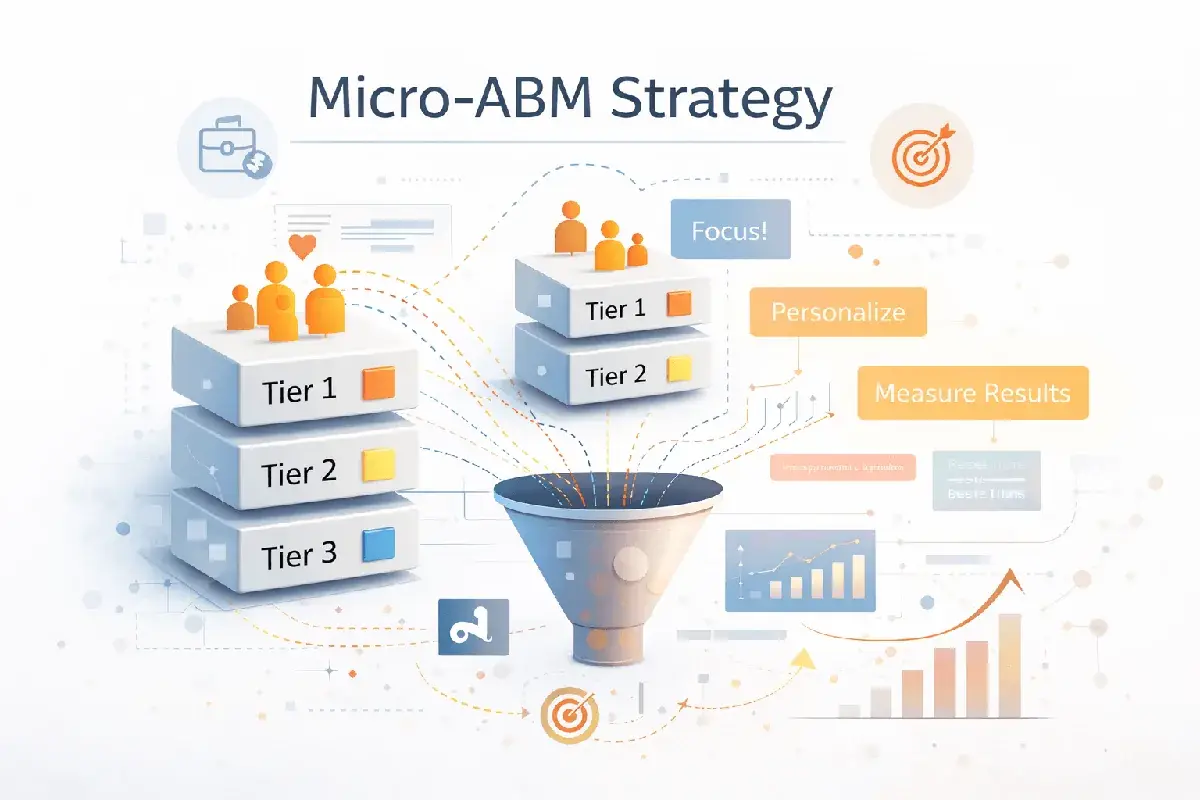
Tier 1 - Premium ABM networks (40% of budget): Account-targeted syndication with intent data verification. Highest CPL but best pipeline conversion.
Tier 2 - Industry-specific publishers (35% of budget): Syndication through vertical media properties that reach your target audience. Good balance of quality and volume.
Tier 3 - Broad reach networks (25% of budget): High-volume syndication for top-of-funnel awareness and database building. Lowest CPL, requires aggressive nurturing.
Network Performance Management
Review network performance monthly and reallocate budget based on:
- Lead acceptance rate: Percentage of delivered leads meeting your ILP criteria
- Speed to engage: How quickly syndicated leads respond to follow-up
- Pipeline contribution: Actual revenue pipeline influenced by each network
- Account coverage: Unique target accounts reached per network
Vendor Selection: Evaluating Syndication Network Partners
Due Diligence Checklist
Before committing budget to any syndication network, conduct thorough due diligence:
Audience verification:
- Request a sample audience overlap analysis with your target account list
- Ask for anonymized demographic breakdowns of their audience
- Verify claimed audience sizes through independent data sources
- Test with a small initial campaign before committing to annual contracts
Lead quality guarantees:
- What is their lead rejection policy and replacement guarantee?
- What percentage of leads typically pass BANT (Budget, Authority, Need, Timeline) qualification?
- Can they provide references from similar B2B technology advertisers?
- What is their average lead acceptance rate across their client base?
Technology and integration:
- Do they offer CRM integration for direct lead delivery?
- Can they integrate with your marketing automation platform?
- What is their lead delivery latency (real-time vs. batch)?
- Do they support custom field mapping and lead routing rules?
Contract Negotiation Tips
- Start with quarterly commitments before signing annual contracts
- Negotiate lead replacement clauses for leads that fail your qualification criteria within 48 hours
- Include performance benchmarks with the right to renegotiate if lead-to-opportunity rates fall below agreed thresholds
- Secure exclusivity options for your product category within the network if budget allows
- Request transparent reporting including source-level data showing which publishers generated each lead
Common Syndication Pitfalls and Solutions
Pitfall 1: Optimizing for CPL instead of pipeline value Solution: Track cost-per-opportunity and pipeline-per-dollar metrics. A EUR 200 lead that converts at 15% is cheaper than a EUR 30 lead that converts at 1%.
Pitfall 2: Treating all syndicated leads equally Solution: Implement progressive scoring and route leads to appropriate nurture tracks based on qualification signals.
Pitfall 3: Poor lead follow-up timing Solution: Respond to syndicated leads within 24 hours through automated email workflows. Speed-to-engagement directly impacts conversion rates.
Pitfall 4: Using generic content across all networks Solution: Customize content versions for different network audiences and buyer stages.
Pitfall 5: Neglecting post-syndication nurture Solution: Build dedicated nurture programs for syndicated leads that progressively qualify and educate before sales engagement.
Results: What Optimized Syndication Delivers
B2B tech companies that implement quality-focused syndication frameworks report:
- 3.2x improvement in lead-to-opportunity conversion compared to volume-only approaches
- 47% reduction in cost per opportunity through better network selection and lead scoring
- 62% higher target account penetration using ABM-targeted syndication networks
- 28% faster sales cycles when syndicated leads are properly qualified and nurtured
Conclusion: Quality Wins in the Long Run
The content syndication debate between quality and quantity is ultimately a false dichotomy. The winning strategy combines both — but with quality as the foundation and quantity as the multiplier.
By implementing rigorous partner evaluation, multi-touch lead scoring, and true value measurement, ABM teams can transform content syndication from a volume play into a precision pipeline engine that delivers measurable revenue impact.
Ready to optimize your ABM content syndication for quality and pipeline impact? MyDigipal specializes in account-based marketing strategies that balance reach with relevance. From AI-powered content creation to advanced email nurture programs, we build syndication programs that deliver qualified pipeline. Contact our team to discuss your content syndication strategy.