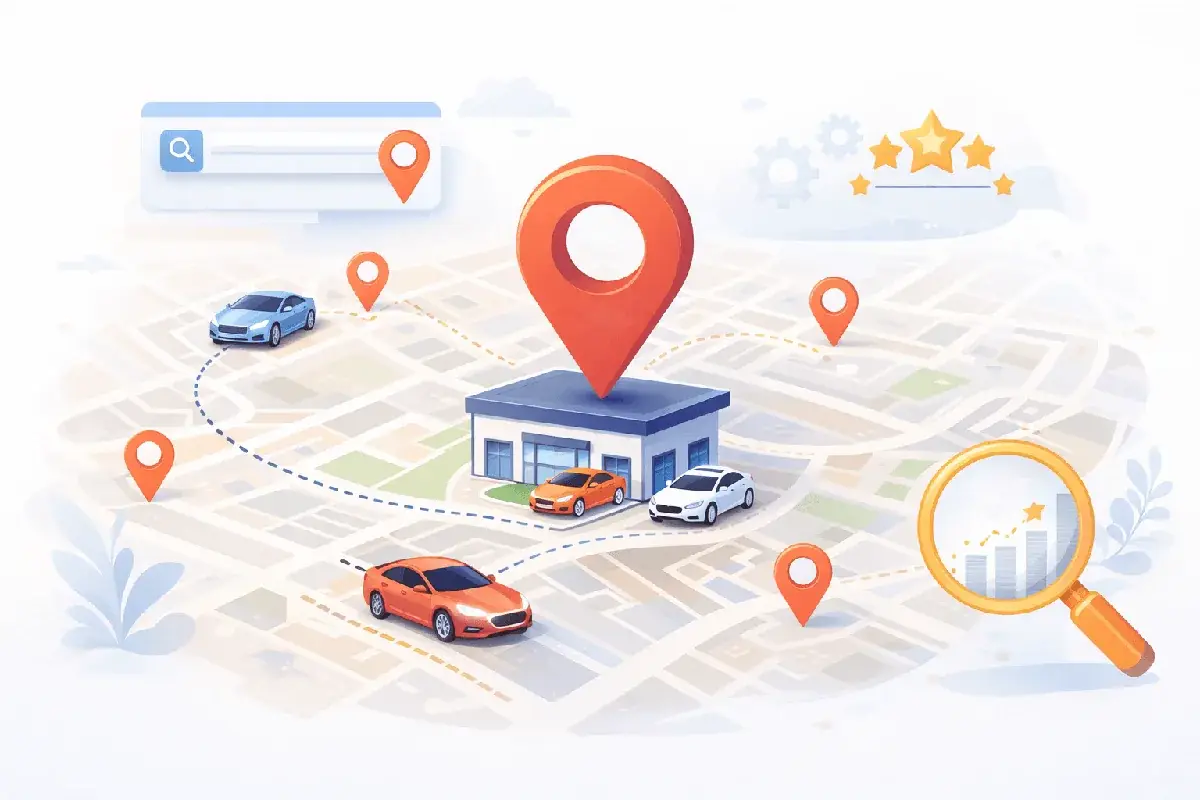
When potential car buyers search for “car dealership near me” or “Toyota dealer in Lyon,” your dealership needs to appear at the top of those results. Local SEO represents the single most cost-effective channel for driving qualified foot traffic to your showroom. According to recent industry data, 78% of local mobile searches result in an offline purchase within 24 hours, making local search optimization a revenue-critical priority for every automotive retailer.
Yet many dealerships still treat local SEO as an afterthought, focusing instead on paid campaigns while leaving significant organic traffic on the table. The reality is that a well-executed local SEO strategy compounds over time, delivering increasingly better results without proportional increases in spend.
In this comprehensive guide, we break down the exact tactics that separate top-performing dealerships from those struggling to capture local search visibility.
Understanding the local Search landscape for dealerships
The automotive purchase journey has fundamentally shifted. Today, 92% of car buyers conduct online research before visiting a dealership, and a significant portion of that research involves local searches. Google processes over 8.5 billion searches daily, with “near me” queries growing by 150% year over year.
For dealerships, this creates both an opportunity and a challenge. The opportunity lies in capturing high-intent buyers at the exact moment they are looking for a vehicle or service in your area. The challenge is that your competitors are fighting for the same limited real estate in local search results.
Local SEO differs from traditional SEO in several key ways. While traditional SEO focuses on ranking for broad keywords nationally or globally, local SEO emphasizes geographic relevance, proximity signals, and local trust factors. Google’s local algorithm weighs three primary factors:
- Relevance: How well your business matches what someone is searching for
- Distance: How close your dealership is to the searcher’s location
- Prominence: How well-known and trusted your business is online and offline
Understanding these factors allows you to build a strategy that addresses each one systematically.
Optimizing your Google business profile for maximum visibility
Your Google Business Profile serves as the cornerstone of your local SEO strategy. This free listing appears in Google Maps, local pack results, and knowledge panels. For dealerships, a fully optimized profile can mean the difference between appearing in the coveted top three local results or being invisible to potential customers.
Start with the fundamentals. Ensure your NAP information (Name, Address, Phone) is accurate and consistent across all platforms. Even small discrepancies like “Street” versus “St.” can create confusion for search engines and dilute your local authority.
Essential profile optimization steps
Complete every available field in your profile. Add your business hours, including special holiday hours. Upload high-quality photos of your showroom, inventory, and team. Dealerships with more than 100 photos receive 520% more calls than those with fewer than ten images.
Select appropriate primary and secondary categories. Your primary category should be specific to your main business, such as “Toyota Dealer” rather than the generic “Car Dealer.” Add secondary categories for related services like “Used Car Dealer” or “Auto Repair Shop.”
Write a compelling business description that incorporates your target keywords naturally. Include your location, brands carried, and unique selling propositions. Avoid keyword stuffing, which can trigger penalties and turn off potential customers.
Enable messaging and quote requests directly through your profile. Dealerships that respond to inquiries within five minutes are 21 times more likely to convert those leads than those responding after 30 minutes.
For a deeper understanding of how to integrate your local SEO efforts with paid campaigns, explore our SEO services designed specifically for performance-driven businesses.
Implementing vehicle schema markup for rich results
Schema markup represents one of the most underutilized local SEO tactics in the automotive industry. This structured data helps search engines understand the specific content on your pages, enabling rich results that stand out in search listings.
For dealerships, vehicle schema markup allows you to display key information directly in search results, including price, mileage, availability, and condition. These enhanced listings capture more attention and generate higher click-through rates than standard results.
The Vehicle listing schema type supports numerous properties that automotive businesses should implement:
| Property | Purpose | Impact on CTR |
|---|---|---|
| vehicleIdentificationNumber | Unique vehicle identifier | Builds trust with serious buyers |
| mileageFromOdometer | Current mileage display | Qualifies leads before click |
| offers (price) | Shows pricing in results | Increases qualified traffic by 35% |
| vehicleModelDate | Year of manufacture | Helps filter intent |
| fuelType | Fuel or energy source | Attracts specific buyer segments |
Beyond vehicle listings, implement LocalBusiness and AutoDealer schema on your main pages. Include aggregate ratings from your review platforms to display star ratings in search results, which can increase click-through rates by up to 30%.
Schema implementation requires technical expertise to avoid errors that could prevent your markup from being recognized. Our team at MyDigipal combines technical SEO expertise with automotive industry knowledge to ensure your structured data delivers measurable results.
Building local backlinks that drive authority
Backlinks remain one of the strongest ranking factors in local SEO. However, not all links are created equal. For dealerships, local and industry-relevant backlinks carry significantly more weight than generic links from unrelated websites.
Focus your link-building efforts on these high-value opportunities:
Local business directories: Beyond Google Business Profile, claim and optimize listings on Yelp, Yellow Pages, and automotive-specific directories like Cars.com and AutoTrader. Ensure NAP consistency across all platforms.
Chamber of commerce memberships: Local chamber websites typically have high domain authority and provide followed links. The investment in membership often pays for itself through SEO value alone.
Local sponsorships and partnerships: Sponsor local sports teams, charity events, or community organizations. These sponsorships typically include website links and also generate positive brand associations.
Industry associations: Membership in automotive trade associations often includes directory listings with valuable backlinks.
Local news and PR: Develop relationships with local journalists and bloggers. Newsworthy events like charity drives, new model launches, or community initiatives can generate high-authority media coverage.
Creating link-worthy content
Develop content that naturally attracts links from local sources. Consider creating:
- Annual reports on local car buying trends
- Guides to local driving routes and destinations
- Comparisons of fuel costs across local stations
- Winter driving safety guides specific to your region
This type of locally-relevant content attracts links from local bloggers, news sites, and community organizations while establishing your dealership as a trusted local authority.
Discover how we helped an automotive group increase organic traffic by 340% through strategic local SEO and content marketing in our case studies.
Managing reviews for local Search success
Reviews influence both your local search rankings and your conversion rates. Google explicitly states that “high-quality, positive reviews from your customers can improve your business visibility.” Beyond the algorithm, 93% of consumers say online reviews impact their purchasing decisions.
Implement a systematic review generation strategy. Train your sales and service teams to request reviews at the point of highest customer satisfaction, typically immediately after a successful purchase or service visit. Send follow-up emails with direct links to your Google review page.
Respond to every review, positive or negative. Thank positive reviewers specifically for their feedback. For negative reviews, respond professionally, acknowledge the concern, and offer to resolve the issue offline. This demonstrates to potential customers that you value feedback and stand behind your service.
| Review Response Time | Impact on Customer Perception |
|---|---|
| Within 24 hours | 45% more likely to visit dealership |
| Within 1 week | 23% more likely to visit dealership |
| No response | 67% less likely to visit dealership |
Monitor reviews across all platforms, not just Google. Facebook, Yelp, DealerRater, and other automotive-specific sites all contribute to your online reputation. Consider using reputation management software to centralize monitoring and response workflows.
Tracking conversions and measuring local SEO ROI
Without proper tracking, you cannot optimize your local SEO strategy or demonstrate its value. Implement comprehensive conversion tracking that captures the full customer journey from search to showroom visit.
Set up goal tracking in Google Analytics for key conversion actions:
- Phone calls from your website
- Form submissions for quotes or appointments
- Clicks on directions or map links
- Chat initiations
- Time spent on vehicle detail pages
Enable call tracking to attribute phone leads to specific marketing channels. Many dealerships receive the majority of their leads via phone, making call tracking essential for accurate ROI measurement.
Use Google Business Profile Insights to monitor how customers find and interact with your listing. Track metrics including search queries used, actions taken, and direction requests. This data reveals which keywords drive the most engagement and where opportunities exist for improvement.
Our tracking and reporting services help dealerships build comprehensive attribution models that connect local SEO efforts directly to showroom visits and vehicle sales.
Integrating local SEO with paid campaigns
Local SEO and paid advertising work best as complementary strategies rather than competing priorities. Dealerships that coordinate their organic and paid efforts achieve significantly better results than those operating in silos.
Use data from your local SEO performance to inform paid campaign targeting. Keywords that perform well organically often convert well in paid search. Geographic areas with strong organic visibility may require less paid investment, allowing you to reallocate budget to underperforming markets.
Conversely, paid campaigns can accelerate results in areas where organic rankings are still developing. Location-specific Google Ads campaigns can capture traffic immediately while your local SEO strategy builds long-term authority.
Social advertising also plays a role in local visibility. Paid social campaigns targeting users within your service area reinforce brand awareness and keep your dealership top of mind throughout the extended automotive purchase journey.
Taking your local SEO strategy to the next level
Local SEO for dealerships is not a one-time project but an ongoing discipline. Search algorithms evolve, competitors adjust their strategies, and customer behaviors shift. Sustainable success requires continuous optimization, monitoring, and adaptation.
Start by auditing your current local SEO performance. Identify gaps in your Google Business Profile, missing schema markup, and opportunities for local link building. Prioritize quick wins that can deliver immediate visibility improvements while building toward longer-term strategic goals.
Remember that local SEO connects directly to revenue. Every improvement in local visibility translates to more qualified visitors to your showroom and more vehicles sold.
Ready to dominate local search in your market? Contact our team at MyDigipal for a free audit of your dealership’s local SEO performance. We specialize in helping automotive businesses capture more traffic, generate more leads, and sell more vehicles through strategic digital marketing.