Car dealerships are leaving money on the table. While competitors fight over expensive generic keywords at €30-80 per lead, smart dealers are generating qualified showroom visits at €5-15 per lead using Google Vehicle Ads (GVA). This cost difference can translate to tens of thousands of euros in savings every month, while simultaneously attracting more qualified prospects.
According to Google’s official documentation, Vehicle Ads help you get in front of auto shoppers at the right moment, with the right listings and information to move them closer to a purchase. This advertising format literally transforms your inventory into a digital showroom accessible to every car buyer actively searching in your area.
This comprehensive guide covers everything you need to dominate Google Vehicle Ads in 2026—from technical setup to advanced optimization strategies.
What are Google vehicle Ads
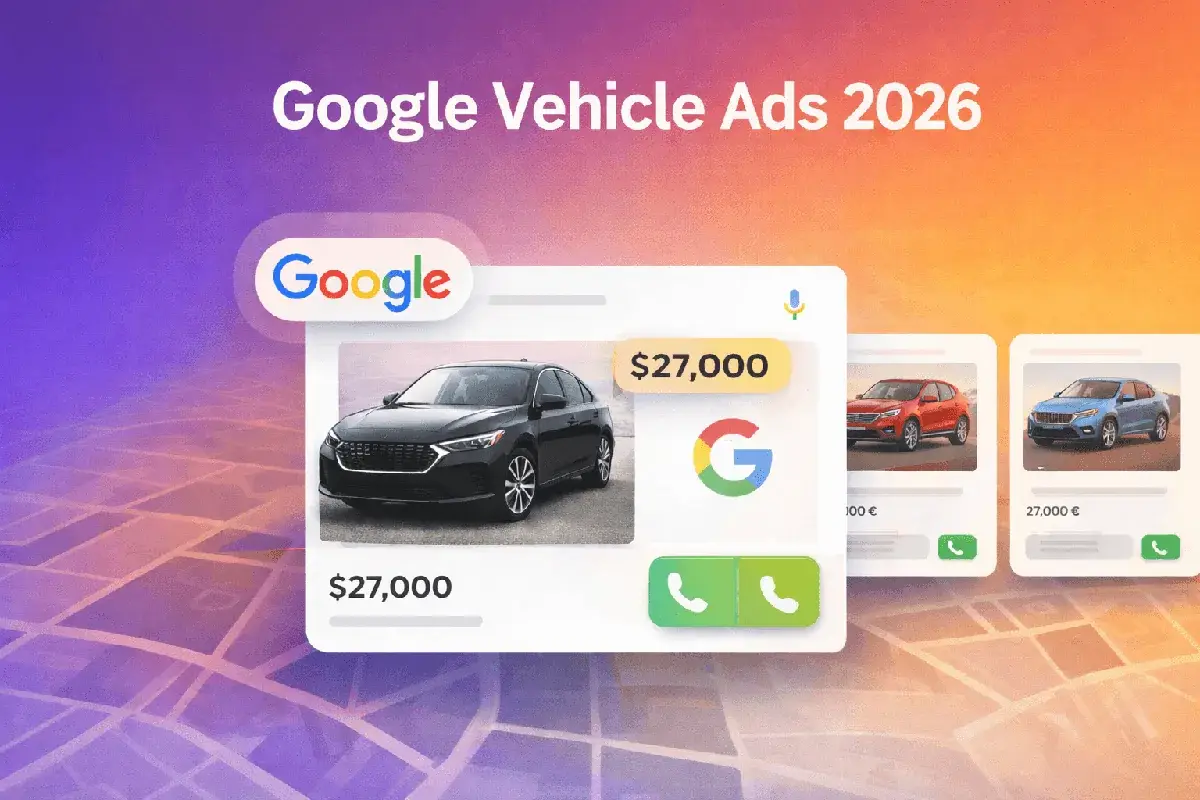
Google Vehicle Ads represents a major evolution in automotive online advertising. Unlike traditional text ads that require you to manually create each campaign, Vehicle Ads use your inventory feed to automatically generate visually rich ads that match exactly what buyers are searching for.
Picture a user typing “BMW X5 near me” into Google. Instead of seeing a simple text ad, they discover the actual BMW X5s available at your dealership, complete with photos, prices, mileage, and distance. This immediate relevance completely changes the conversion equation.
The table below summarizes the key elements users see when they discover your Vehicle Ads:
| Element | What Users See |
|---|---|
| Vehicle image | High-quality photo of the actual car |
| Make and model | ”2024 BMW X5 xDrive40i” |
| Price | Real price (compliance required) |
| Mileage | For used vehicles |
| Dealer name | Your dealership brand |
| Location | Distance from searcher |
This total transparency offers a considerable advantage: only buyers genuinely interested in your vehicles click the ad. You’re paying solely for qualified traffic, which explains the significantly lower cost per lead compared to traditional channels.
European availability and market opportunity
The good news for European dealerships is that Google Vehicle Ads is now fully available across major markets including France, UK, Netherlands, and Germany (in open beta). However, adoption remains relatively low compared to the United States, representing an exceptional window of opportunity for early adopters.
Dealerships positioning themselves on this channel now benefit from several advantages: lower cost-per-click due to limited competition, maximum visibility in search results, and a learning curve that will help them dominate once competitors wake up to the opportunity.
| Region | Status | Competition Level |
|---|---|---|
| United States | Fully available | High |
| United Kingdom | Fully available | High |
| France | Fully available | Low - Opportunity |
| Germany | Open beta | Medium |
Why vehicle Ads outperform traditional campaigns
To understand the superiority of Vehicle Ads, you need to analyze the modern automotive buying journey. Today’s car buyer performs an average of 900 digital interactions before making a purchase. They compare prices, read reviews, and most importantly, search for specific vehicles on Google.
Traditional Search campaigns attempt to capture this intent with broad keywords like “BMW dealership Paris” or “buy used car.” The problem? These queries attract a mix of prospects at different stages of the buying journey, many of whom aren’t ready to convert.
Vehicle Ads, by contrast, intercept the buyer at the most critical moment: when they’re searching for a specific vehicle and actively comparing options. The difference shows directly in acquisition costs.
| Channel | Typical CPL | Lead Quality | Complexity |
|---|---|---|---|
| Google Search (generic) | €30-80 | Medium | Low |
| Automotive portals | €20-50 | Low-Medium | Low |
| Display advertising | €40-100 | Low | Medium |
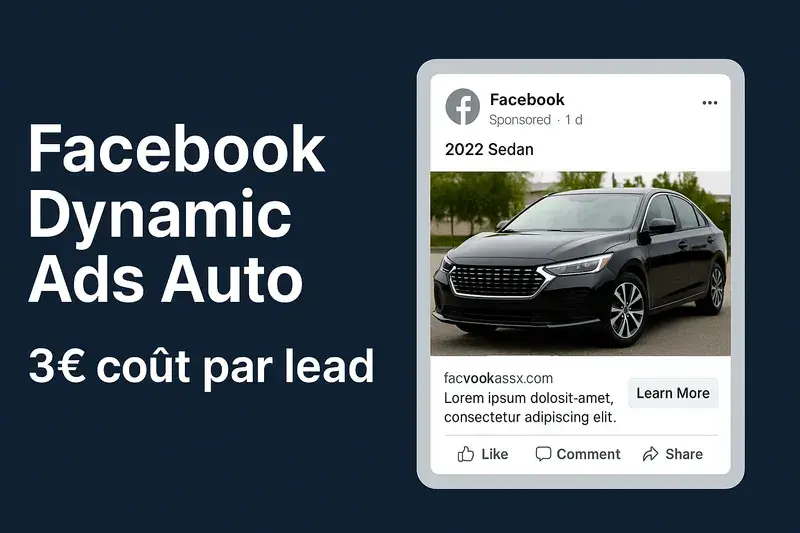
| Facebook Dynamic Ads | €3-10 | High | Medium |
| Google Vehicle Ads | €5-15 | Very High | Medium-High |
These numbers speak for themselves, but they don’t tell the whole story. The real value of Vehicle Ads lies in the quality of generated leads. A prospect who clicks on a Vehicle Ad has already seen the vehicle, the price, and knows it’s available at your dealership. All that’s left is closing the sale.
The factors behind superior Performance
Several psychological and technical mechanisms explain why Vehicle Ads convert better than other advertising formats.
First, intent matching is perfect. Users see exactly what they’re searching for, creating an immediate connection. Second, visual confirmation eliminates curiosity clicks: if the vehicle doesn’t match their expectations, users simply don’t click. Third, price transparency naturally filters prospects who aren’t in the right budget range.
Finally, local relevance plays a crucial role. A buyer who sees a dealership is 15km away is much more likely to visit than a prospect who needs to travel across the region to see a showroom.
Technical setup: the fundamentals
Setting up Google Vehicle Ads requires rigorous technical preparation. Unlike classic Search campaigns where you can launch within hours, Vehicle Ads demand solid data infrastructure. This initial investment is largely offset by the channel’s long-term efficiency.
The first step is ensuring all prerequisites are in place. You’ll need an active Google Ads account in good standing, a Google Merchant Center configured specifically for vehicles, and a verified Google Business Profile linked to your account. Without these foundations, Vehicle Ads simply won’t work.
Conversion tracking deserves particular attention. You should be able to measure not only form submissions but ideally also phone calls and test drive requests. The more complete your tracking, the better you can optimize your campaigns.
The vehicle feed: your key to success
Your inventory feed is literally the fuel for your Vehicle Ads. An incomplete or poorly structured feed will drastically limit your ad visibility. Conversely, a rich, well-optimized feed gives you a significant competitive advantage.
Required fields must be filled accurately. The title should follow the format “Year + Make + Model + Trim” to maximize relevance. The description, while less visible, helps the algorithm understand your vehicle and match it with the right queries.
| Field | Type | Example | Importance |
|---|---|---|---|
| id | String | ”VIN123456789” | Unique identification |
| title | String | ”2024 BMW X5 xDrive40i” | Very high |
| price | String | ”65000.00 EUR” | Critical |
| mileage | Object | value: 15000, unit: KM | High for used |
| image_link | URL | Primary image URL | Very high |
Beyond required fields, optional fields like color, transmission type, or fuel can increase your impressions by 15 to 25%. Google uses this information to display your vehicles on more specific queries, like “blue electric SUV Paris area.”
The critical importance of images
In such a visual format as Vehicle Ads, photo quality can make or break your performance. Google imposes strict rules: no overlays, no watermarks, no logos. The vehicle must be fully visible, with a minimum resolution of 800x600 pixels.
Our analysis shows that professional photos taken from a 3/4 front angle generate 30% higher CTR compared to amateur shots. This investment in visual quality quickly pays for itself in saved clicks and improved conversions.
A common mistake is using generic images or “photo coming soon” placeholders. Google systematically rejects these images, and even if they passed, they would destroy your performance. Every vehicle in your inventory must have its own photos reflecting its actual condition.
Pricing compliance: a major point of vigilance
Google’s “Dishonest Pricing Practices” policy is now strictly enforced. This evolution reflects Google’s commitment to protecting user experience and maintaining trust in the Vehicle Ads format.
Concretely, this means the price displayed in your ad must match exactly what the customer will pay. All mandatory fees must be included. If a vehicle shows €25,000 in the ad, the landing page must display the same price.
Violations are taken very seriously. A first infraction triggers a warning with a few days to correct. Persistent issues result in ad suspension, and repeated violations can lead to complete account suspension.
Our recommendation: set up automated auditing of your pricing feed. Compare daily the prices in your feed with those displayed on your site. This vigilance will save you from costly campaign interruptions.
Campaign structure: optimal organization
A good campaign structure is essential for maximizing performance while maintaining control over your investments. We recommend segmenting campaigns by vehicle type, allowing you to adapt budgets and bids to different market dynamics.
New and used vehicles don’t have the same margins, sales cycles, or audiences. Treating them in the same campaign means flying blind. By separating them, you can allocate more budget to the most profitable segments and adjust your bidding strategy accordingly.
| Campaign | Targeting | Recommended Budget Allocation |
|---|---|---|
| GVA - New Vehicles | New inventory only | 40% |
| GVA - Certified Pre-Owned | CPO inventory | 25% |
| GVA - Used Vehicles | Non-CPO used | 25% |
| GVA - Conquest | Competitor brand searches | 10% |
The “Conquest” campaign deserves explanation. It targets users searching for brands you don’t sell directly but who might be interested in your alternatives. For example, someone searching “Audi Q5” might be interested in your BMW X3. This strategy requires more finesse but can generate conversions at lower cost.
Budget sizing
The optimal budget depends on several factors: inventory size, catchment area, and volume objectives. A budget that’s too low will limit your visibility and algorithmic learning. An excessive budget risks generating more leads than your sales team can handle.
For a single dealership with 50 to 100 vehicles in inventory, a monthly budget of €1,500 to €5,000 is a good starting point. This amount generates between 100 and 350 qualified leads per month, sufficient volume to test, learn, and optimize.
Dealer groups can pool their efforts for efficiency gains. A regional group of 5 to 10 sites can target €5,000 to €20,000 monthly, while national networks typically invest between €20,000 and €100,000.
Advanced optimization strategies
Once your campaigns are live, the optimization work begins. The best performance comes from continuous improvement based on data. Each week, you should analyze your KPIs and identify improvement levers.
Feed optimization is often the most impactful lever. Adding all optional fields can increase impressions by 15 to 25%. Improving photo quality can boost CTR by 30%. Daily feed updates improve relevance by 20% by avoiding showing sold vehicles or outdated prices.
| Metric | Target | Action if Below |
|---|---|---|
| CTR | More than 3% | Improve images and titles |
| Conversion rate | More than 5% | Audit landing pages |
| CPL | Under €15 | Refine targeting |
| Impression share | More than 60% | Increase budget |
Search term analysis deserves weekly attention. You’ll discover irrelevant queries to exclude (saving budget) and high-performing queries to exploit further. It’s also a goldmine for understanding how your prospects think and formulate their searches.
Mistakes that tank Performance
Certain mistakes frequently recur among dealerships starting with Vehicle Ads. The most costly is maintaining stale inventory in the feed. Every click on a sold vehicle is pure waste, and the bad user experience hurts your reputation.
Low-quality images are another source of chronic underperformance. In a visual format, you’re competing directly with other dealerships. Dark, poorly framed, or unflattering photos immediately disadvantage you.
Finally, the absence of negative keywords lets your budget scatter across irrelevant queries. Someone searching “BMW X5 spare parts” or “BMW X5 problems” probably isn’t a buyer. These exclusions should be reviewed regularly.
Integration into your global strategy
Vehicle Ads reach their full potential when integrated into a comprehensive automotive marketing strategy. They excel at capturing high-intent prospects but shouldn’t be your only channel.
Facebook Dynamic Ads perfectly complement Vehicle Ads. Where Google captures explicit intent (someone actively searching), Facebook excels at generating awareness and retargeting. A user who saw your Vehicle Ads without clicking can be reached later on Facebook with the same vehicle.
Feed sharing between these channels considerably simplifies management. The same data infrastructure feeds Google, Facebook, and potentially other channels like Instagram or automotive portals. This consistency ensures your inventory is always up-to-date everywhere.
Measuring true ROI
Vehicle Ads ROI calculation must account for the entire customer journey, not just cost per lead. A €10 lead that never converts is more expensive than a €15 lead that buys.
Let’s take a concrete example for an average dealership. With a monthly budget of €3,000 and €10 CPL, you generate 300 leads. If 25% of these leads visit the showroom (75 visitors) and you close 30% of them, you make approximately 22 sales per month via this channel.
With an average profit of €1,200 per sale, your monthly return reaches €26,400 for a €3,000 investment. That’s an 8x ROI, far superior to most traditional marketing channels.
| Metric | Value | Calculation |
|---|---|---|
| Monthly budget | €3,000 | Investment |
| Leads generated | 300 | Budget / CPL |
| Showroom visitors | 75 | Leads x 25% |
| Sales | 22 | Visitors x 30% |
| Monthly ROI | €26,400 | Sales x Profit |
Use our marketing ROI calculator to model your specific situation with your own conversion rates.
Take action
Dealerships mastering Google Vehicle Ads today are building a lasting competitive advantage. While your competitors continue paying €50 or more per lead on traditional channels, you can acquire more qualified prospects at a fraction of the cost.
Implementation requires an initial investment in time and technical resources. But once the infrastructure is in place, the system runs largely on autopilot, generating a constant flow of qualified leads directly into your CRM.
Ready to launch Google Vehicle Ads for your dealership? Explore our automotive Google Ads management services, or contact our team for a free audit of your current setup and personalized recommendations.
Sources: